
Displaced. Paralyzed. Anticipating. What are they anticipating? To leave their hometown? Arrive in a new country? Integrate in the new society, get a residence permit, a job, a life in a new place? No one reveals when this waiting will be over—neither guarantees it.
Displaced. Paralyzed. Anticipating. What are they anticipating? To leave their hometown? Arrive in a new country? Integrate in the new society, get a residence permit, a job, a life in a new place? No one reveals when this waiting will be over—neither guarantees it.
Photo by Marie Dorigny
Photo by Marie Dorigny
Forceful displacement, marginalization, and different forms of oppression frequently drive people towards migration, in search for a more viable environment. Certainly, people migrate to gain new experiences and build their own identity and life, or for other personal reasons—much like most international students do. However, in more extreme conditions, such as war and political crisis, people experience entrapment by larger systemic forces, urging them to flee.
It is the waiting as an integral part of the journey that challenges immigrants, mostly refugees. The endless paperwork, the insecurity both before, during, and after their migration, and the entrapment in a constant state of transition from one place to the next burdens those who leave and frightens those who don’t. Even after leaving the oppressive environment, refugees are continuously confronting new barriers, positioning them in a vicious cycle of uncertainty, regret and ultimately, emotional paralysis.
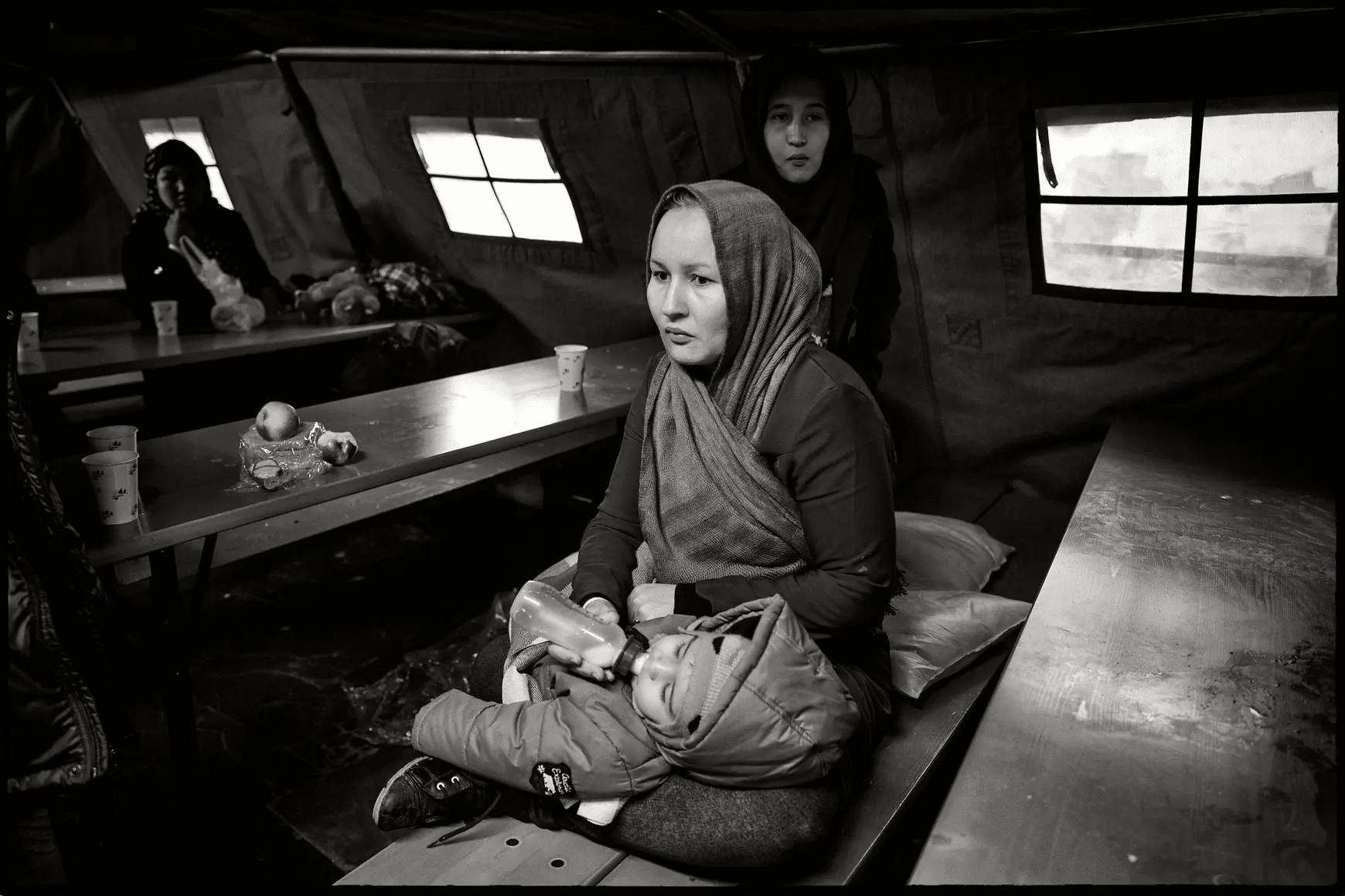
I cannot help but refer to the ingenious photography project “Displacement: Women in Exile” by Marie Dorigny (2015) that captures the instability and fear of women forced to migrate by war conditions. Dorigny establishes closeness between the viewer and the women, providing an accurate, heartfelt insight into the challenges they must overcome. In a particular photo, women are waiting at Passau station in Germany to continue their long journey.
The focal point of the image is clearly a woman bottle-feeding her child, with a feeling of dejection in her eyes. The interplay between light and shadow, emphasizing the woman’s face, conveys her vulnerability but also resilience. She is holding the baby in a way devoid of tenderness, which epitomizes her sense of paralysis and entrapment in the externally-imposed circumstances.
Behind her, the women are also caught in motion, eating and walking. Their close proximity alludes to their solidarity, yet the three women gaze in different directions, capturing their sense of isolation within their shared experience. The setting of the tent-like structure and the disposable caps scattered everywhere effectively visualize their lack of permanence and security.
“The interplay between light and shadow, emphasizing the woman’s face, conveys her vulnerability but also resilience.”
These immigrants are in constant motion and yet they are paralyzed, experiencing emotional struggles that threaten their psychological and physical health. Indeed, migrants have been reported to be vulnerable to a number of mental disorders. Refugees exhibit rates of post-traumatic stress disorder (PTSD) ten times higher than the general population (Fazel, Wheeler and Danesh, 2005). This is followed by high depression and anxiety rates (Turrini et al., 2017). All of these mental illnesses are associated with the pre-migration experience of war and violence, the displacement and, finally, the post-migration challenges in the “welcoming” countries (Miller and Rasmussen, 2010).
Migrants know that even when they reach their final destination, their journey will not be over; the post-migration struggles will begin. They will still receive the indignation of society, the ICE-cold looks of public services and governmental bodies, and be partially blamed in case of an economic depression.
Of course, their displacement will not end there—not even after a couple of decades of residing in another country and growing their own family. Not even when their child speaks the local language fluently and attends school, as all other children do. Especially not when their child is being detained and questioned like a violent criminal, with their surname and skin colour treated as unshakeable evidence.
Apparently, people can be illegal. Kids, much like drugs or other goods, can be illegal. Solely based on their ethnicity, people must go through exhaustive paperwork, injustice and wait through other challenges, just to be considered part of a community. No matter how long they stay there, they remain “aliens”.
This maladjustment into the new environment and the rejection by their new community can potentially serve as a vulnerability factor, predisposing people towards a number of mental disorders. A recent study examined the effects of oppression on immigrants that had spent most of their childhood in the U.S., using the Trauma Symptoms of Discrimination Scale (TSDS). As expected, trauma symptoms were positively correlated with discrimination and racial microaggressions, a relationship that was stronger for lifetime experiences rather than recent. This emphasizes the effect of the accumulation of oppression on chronic trauma. TSDS was strongly correlated with PTSD measures, followed by depression and anxiety scales (Williams et al., 2023). In whole, it is astonishing how deteriorating mental health is associated with immigrants that have lived many years in the USA, spent most of their childhood there, and have a great command of the English language.
Not only in America, but in other parts of the world, getting citizenship and legal rights to vote and reside in a country are near impossible tasks. Coming from Greece, I have many friends that were born and raised in the same city as me, speak the same language and attend the same school, yet have to wait decades, or have to pay ridiculous amounts, to get a Greek ID. And here I am, living in another country, and I have the right to vote in my hometown, but my friends, who have been living there their entire life, cannot. Am I more implicated in the societal life of Greece than the people who stayed there their whole life?
“They will still receive the indignation of society, the ICE-cold looks of public services and governmental bodies, and be partially blamed in case of an economic depression.”
It is quite evident that many governments are not welcoming to migrants and ultimately refuse their integration in society. Nonetheless, migration and colonization have taken place for centuries. Who is, thus, not a migrant? Who is then legal, and who determines such? If ethnicity determines one’s “legality” and belongingness to a country, good luck trying to map everyone’s generational trees.
Another enervating piece of propaganda is that of the threat that immigrants pose to the economic growth of a country. People are told and still entertain the belief that immigrants will take their jobs; “they are the cause of our misfortunes, our financial struggles, and unemployment”. They, even though they are frequently exploited by industries that “promise” to protect them and help them survive, in exchange for being underpaid and overworked.
Yes, truly, the immigrants steal jobs… They are at fault for our ever-ending strive to survive, which we in futility continuously attempt to resolve by working harder and harder. They are the reason we have to pay for education, healthcare, and a roof upon our heads. The reason we don’t feel safe to walk alone at night in a city; because they are criminals. Certainly, not billionaires and enterprise owners, profiting off other people’s (including our) labour. However, not all immigrants are bad or have to undergo challenges to live; Arab business magnates are welcome! They are not criminals. Arabic women refugees are, though. They need their papers reviewed for decades to be welcome, and even more time to fend themselves from the community’s discrimination and racism.
I hope it is clear how racism and barriers to immigration are solely dependent on social class and profit. Besides, this is how racism is propagated: fear for one’s own survival is used to turn similar people against each other, rather than against those above them. Pretty convenient, at the very least.
Challenges are never-ending for those who migrate. Among the worst of them all is the waiting. Wait for every train in every station to drive you to a new place, where you will wait for your papers to be reviewed, wait to find a job, a proper house, security and… belonging.
The song “Let Down” by Radiohead captures this feeling of emotional detachment stemming from constant transit, which seems uncontrollable and externally imposed. A feeling of numbness, of being the quiescent spectator in your own life, waiting in disappointment and inaction.
Yes, Thom Yorke, waiting does drive you crazy.
References
– Estrin, J. (2016, August 30). How a French Photographer Made Intimate Photos of Female Refugees. Lens Blog. https://archive.nytimes.com/lens.blogs.nytimes.com/2016/08/30/how-a-french-photographer-made-intimate-photos-of-female-refugees/
– Fazel, M., Wheeler, J., & Danesh, J. (2005). Prevalence of serious mental disorder in 7000 refugees resettled in western countries: a systematic review. The Lancet, 365(9467), 1309–1314. https://doi.org/10.1016/s0140-6736(05)61027-6
– Miller, K. E., & Rasmussen, A. (2010). War exposure, daily stressors, and mental health in conflict and post-conflict settings: Bridging the divide between trauma-focused and psychosocial frameworks. Social Science & Medicine, 70(1), 7–16. https://doi.org/10.1016/j.socscimed.2009.09.029
– Turrini, G., Purgato, M., Ballette, F., Nosè, M., Ostuzzi, G., & Barbui, C. (2017). Common mental disorders in asylum seekers and refugees: umbrella review of prevalence and intervention studies. International Journal of Mental Health Systems, 11(1). https://doi.org/10.1186/s13033-017-0156-0
– Williams, M., Osman, M., & Hyon, C. (2023). Understanding the Psychological Impact of Oppression Using the Trauma Symptoms of Discrimination Scale. Chronic Stress, 7(1), 247054702211495. https://doi.org/10.1177/24705470221149511
Forceful displacement, marginalization, and different forms of oppression frequently drive people towards migration, in search for a more viable environment. Certainly, people migrate to gain new experiences and build their own identity and life, or for other personal reasons—much like most international students do. However, in more extreme conditions, such as war and political crisis, people experience entrapment by larger systemic forces, urging them to flee.
It is the waiting as an integral part of the journey that challenges immigrants, mostly refugees. The endless paperwork, the insecurity both before, during, and after their migration, and the entrapment in a constant state of transition from one place to the next burdens those who leave and frightens those who don’t. Even after leaving the oppressive environment, refugees are continuously confronting new barriers, positioning them in a vicious cycle of uncertainty, regret and ultimately, emotional paralysis.
I cannot help but refer to the ingenious photography project “Displacement: Women in Exile” by Marie Dorigny (2015) that captures the instability and fear of women forced to migrate by war conditions. Dorigny establishes closeness between the viewer and the women, providing an accurate, heartfelt insight into the challenges they must overcome. In a particular photo, women are waiting at Passau station in Germany to continue their long journey.
The focal point of the image is clearly a woman bottle-feeding her child, with a feeling of dejection in her eyes. The interplay between light and shadow, emphasizing the woman’s face, conveys her vulnerability but also resilience. She is holding the baby in a way devoid of tenderness, which epitomizes her sense of paralysis and entrapment in the externally-imposed circumstances.
Behind her, the women are also caught in motion, eating and walking. Their close proximity alludes to their solidarity, yet the three women gaze in different directions, capturing their sense of isolation within their shared experience. The setting of the tent-like structure and the disposable caps scattered everywhere effectively visualize their lack of permanence and security.
“The interplay between light and shadow, emphasizing the woman’s face, conveys her vulnerability but also resilience.”
These immigrants are in constant motion and yet they are paralyzed, experiencing emotional struggles that threaten their psychological and physical health. Indeed, migrants have been reported to be vulnerable to a number of mental disorders. Refugees exhibit rates of post-traumatic stress disorder (PTSD) ten times higher than the general population (Fazel, Wheeler and Danesh, 2005). This is followed by high depression and anxiety rates (Turrini et al., 2017). All of these mental illnesses are associated with the pre-migration experience of war and violence, the displacement and, finally, the post-migration challenges in the “welcoming” countries (Miller and Rasmussen, 2010).
Migrants know that even when they reach their final destination, their journey will not be over; the post-migration struggles will begin. They will still receive the indignation of society, the ICE-cold looks of public services and governmental bodies, and be partially blamed in case of an economic depression.
Of course, their displacement will not end there—not even after a couple of decades of residing in another country and growing their own family. Not even when their child speaks the local language fluently and attends school, as all other children do. Especially not when their child is being detained and questioned like a violent criminal, with their surname and skin colour treated as unshakeable evidence.
Apparently, people can be illegal. Kids, much like drugs or other goods, can be illegal. Solely based on their ethnicity, people must go through exhaustive paperwork, injustice and wait through other challenges, just to be considered part of a community. No matter how long they stay there, they remain “aliens”.
This maladjustment into the new environment and the rejection by their new community can potentially serve as a vulnerability factor, predisposing people towards a number of mental disorders. A recent study examined the effects of oppression on immigrants that had spent most of their childhood in the U.S., using the Trauma Symptoms of Discrimination Scale (TSDS). As expected, trauma symptoms were positively correlated with discrimination and racial microaggressions, a relationship that was stronger for lifetime experiences rather than recent. This emphasizes the effect of the accumulation of oppression on chronic trauma. TSDS was strongly correlated with PTSD measures, followed by depression and anxiety scales (Williams et al., 2023). In whole, it is astonishing how deteriorating mental health is associated with immigrants that have lived many years in the USA, spent most of their childhood there, and have a great command of the English language.
Not only in America, but in other parts of the world, getting citizenship and legal rights to vote and reside in a country are near impossible tasks. Coming from Greece, I have many friends that were born and raised in the same city as me, speak the same language and attend the same school, yet have to wait decades, or have to pay ridiculous amounts, to get a Greek ID. And here I am, living in another country, and I have the right to vote in my hometown, but my friends, who have been living there their entire life, cannot. Am I more implicated in the societal life of Greece than the people who stayed there their whole life?
“They will still receive the indignation of society, the ICE-cold looks of public services and governmental bodies, and be partially blamed in case of an economic depression.”
It is quite evident that many governments are not welcoming to migrants and ultimately refuse their integration in society. Nonetheless, migration and colonization have taken place for centuries. Who is, thus, not a migrant? Who is then legal, and who determines such? If ethnicity determines one’s “legality” and belongingness to a country, good luck trying to map everyone’s generational trees.
Another enervating piece of propaganda is that of the threat that immigrants pose to the economic growth of a country. People are told and still entertain the belief that immigrants will take their jobs; “they are the cause of our misfortunes, our financial struggles, and unemployment”. They, even though they are frequently exploited by industries that “promise” to protect them and help them survive, in exchange for being underpaid and overworked.
Yes, truly, the immigrants steal jobs… They are at fault for our ever-ending strive to survive, which we in futility continuously attempt to resolve by working harder and harder. They are the reason we have to pay for education, healthcare, and a roof upon our heads. The reason we don’t feel safe to walk alone at night in a city; because they are criminals. Certainly, not billionaires and enterprise owners, profiting off other people’s (including our) labour. However, not all immigrants are bad or have to undergo challenges to live; Arab business magnates are welcome! They are not criminals. Arabic women refugees are, though. They need their papers reviewed for decades to be welcome, and even more time to fend themselves from the community’s discrimination and racism.
I hope it is clear how racism and barriers to immigration are solely dependent on social class and profit. Besides, this is how racism is propagated: fear for one’s own survival is used to turn similar people against each other, rather than against those above them. Pretty convenient, at the very least.
Challenges are never-ending for those who migrate. Among the worst of them all is the waiting. Wait for every train in every station to drive you to a new place, where you will wait for your papers to be reviewed, wait to find a job, a proper house, security and… belonging.
The song “Let Down” by Radiohead captures this feeling of emotional detachment stemming from constant transit, which seems uncontrollable and externally imposed. A feeling of numbness, of being the quiescent spectator in your own life, waiting in disappointment and inaction.
Yes, Thom Yorke, waiting does drive you crazy.
