
Photo by Andrés Silva
I grew up hearing stories from my family about what Venezuela was like before the dictatorship. In the fifties, the country was flourishing: the price of oil was higher than ever and the universities were earning unprecedented prestige. It was a time of unbounded possibilities for this emerging nation. After World War II, many Europeans who were forced to emigrate fled to Venezuela: the country’s foreign-born population increased to ten times its original size in only two decades, from 1941 to 1961. My great-grandparents are part of this statistic, along with my grandmother and my great-aunt. When I asked my great-aunt how life was back then, the description she gave me was heartbreaking: “There were no blackouts, there was always food in the supermarket, there was always gasoline at the gas station.” She simply described what we know as normal life, yet the country’s present reality makes that normality noteworthy.
Hugo Chávez’s regime began in 1999. Less than a year into his presidency, he put forward a new constitution giving him more power than any president before him. Additionally, he implemented “re-election”, enabling the president to run for elections indefinitely. Apart from the evident intragovernmental corruption, inflation kept sinking the country into poverty. The government’s policies were rapidly eroding the country’s economic and social stability.
When the people started rebelling against the corrupt reforms, military brutality quickly escalated. The government ordered the military to shoot at citizens during protests that were meant to be peaceful. Hundreds were arrested and killed. Nevertheless, the thought of succumbing to tyranny never crossed people’s minds. In 2007, my parents left one-year-old me with my grandparents to go to one of the routine monthly protests, which they never missed. That day, they were unexpectedly attacked by one of the armed bands financed by the government. Two people were shot and killed just a few meters away from them. While trying to take cover, they lost each other in the crowd. My mother hid behind a car and quickly got under it. She tells me that while she lay on the concrete that day, all she could think about was me. After that incident, my parents agreed to take turns attending the protests. This way, they ensured I would never be left behind alone if anything happened. They were scared, for themselves and for me, but stopping the fight was not an option. My mom explains that at the time she could not bear the thought of comfortably staying home while there was a massacre in the streets. She says, “I felt it was my undeniable responsibility as a citizen to go out and demand justice”.
A year later, in February of 2008, my mother and father decided to leave the country. Apart from the protests, there was unrestrained violence in daily life: innocent citizens were assaulted on the street, in their homes, and outside of work. People were often abducted and their families were asked for ransoms in exchange for their lives, which not everyone could pay. By this point, my parents were living every day in constant fear. My mom used to count the minutes my dad took to drive from his office back home, afraid that if there was a delay, it meant something had happened to him. They started to feel that their lives were in increasing danger and, in my mother’s words, statistically they were next. Thanks to a relocation offered by the company my dad worked for, we were able to leave comfortably. My mom often tells the story of how on the day we left, while the plane was taking off, I shouted “Goodbye Venezuela”. I was thrilled by the idea of flying for the first time, but I had no idea that the goodbye I was saying was not only my family’s final goodbye to our homeland, but also that of most others on that plane.
We were lucky with our emigration process, but most people were not. Since the military and economic crisis worsened in 2013, every year hundreds of thousands have fled the country by foot through the jungle toward Colombia, Panama, or other neighbouring countries. During this crossing, people are often raped, trafficked, or killed. Life does not get much easier when you reach your destination: every Venezuelan knows an excellent medic, architect, or engineer who has to work a minimum-wage job abroad because they cannot get employed in their field. It is also common to feel looked down upon by other Latin Americans when you are a Venezuelan immigrant. I, like millions of others, grew up living in a culture that did not feel like mine, never feeling fully accepted. It is also important to consider the emotional impact of leaving behind all you have ever known in a risky gamble for a better future. Leaving is a liability disguised as a choice.
However, staying entails a far greater cost. Staying means surrendering your freedom to the regime. Between 2013 and 2019, more than 300 people died in protests, most of them university students. The thought of police throwing tear gas bombs or purposefully firing bullets at students’ heads is simply inconceivable in a country like the Netherlands, yet it has been a reality in Venezuela for many years. People are threatened and even arrested if they speak out against the regime, or even if they have a relative who does. Just last year my great-aunt, who still lives in Caracas, was constantly stopped by the military to have her phone searched to see “if she was conspiring against the government”. My great-aunt is 80 years old. It is evident that the primary means by which the regime prolongs the nation’s oppression is fear.
After living through so much loss, hardship, and uncertainty, it would be easy to assume that Venezuelans are now a people who have become hardened by grief. Instead, we choose to celebrate life by finding light in difficulty, carrying pride without bitterness. Venezuelans bring their culture and essence wherever they are: our food, our music, our accent, our expressions. It does not matter what corner of the world a Venezuelan might be in, we remain absolutely true to our roots, always proud of our origins. The popular song “Venezuela” by Herrero Ibarz and Armenteros Sánchez opens with the lyric “Llevo tu luz y tu aroma en mi piel”, which translates to “I carry your light and your scent on my skin”. This ode to Venezuela and its people, written long before our massive exodus, unintentionally summarizes our immigration perfectly: a people forced to pack their lives in a couple of suitcases and leave everything behind was allowed to take solely their national pride with them, fueled by memories and by the hope of one day being able to return home. The hope of reuniting with the family they left behind and the opportunity of showing their beloved homeland to the family they made abroad.
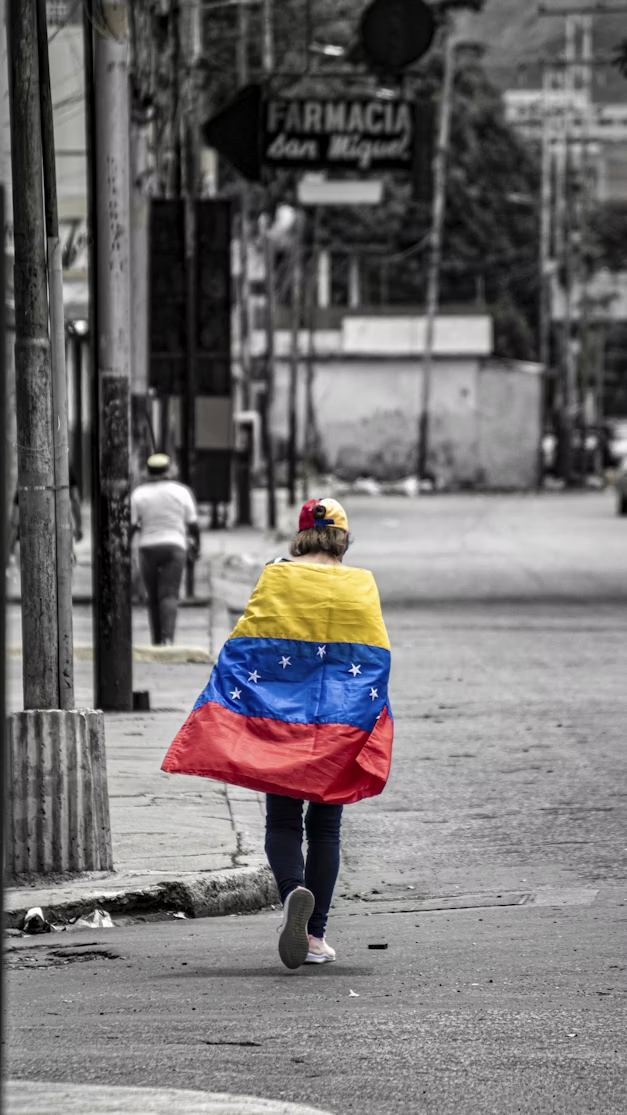
The Venezuelan national anthem is titled Glory to the Brave People. Glory to all who fight and resist in the name of the rebirth of our nation. Glory to all who remain and preserve Venezuela from the inside. Glory to all who embody our values and honor our culture across the world. I carry my flag with immense pride because of what it symbolizes: the guiding hope that keeps strength and courage alive in those who stayed and those who left by reminding us of who we are. In this relentless fight for liberty, we are moved above all by the love for what we lost, and believe me when I say that love is undying. No matter how long the wait, I am certain we will see the sun rise on our plains, forests, and coasts again. In the meantime, we will continue to stand proud, telling the world the story of our homeland and its brave people.
Photo by Andrés Silva
I grew up hearing stories from my family about what Venezuela was like before the dictatorship. In the fifties, the country was flourishing: the price of oil was higher than ever and the universities were earning unprecedented prestige. It was a time of unbounded possibilities for this emerging nation. After World War II, many Europeans who were forced to emigrate fled to Venezuela: the country’s foreign-born population increased to ten times its original size in only two decades, from 1941 to 1961. My great-grandparents are part of this statistic, along with my grandmother and my great-aunt. When I asked my great-aunt how life was back then, the description she gave me was heartbreaking: “There were no blackouts, there was always food in the supermarket, there was always gasoline at the gas station.” She simply described what we know as normal life, yet the country’s present reality makes that normality noteworthy.
Hugo Chávez’s regime began in 1999. Less than a year into his presidency, he put forward a new constitution giving him more power than any president before him. Additionally, he implemented “re-election”, enabling the president to run for elections indefinitely. Apart from the evident intragovernmental corruption, inflation kept sinking the country into poverty. The government’s policies were rapidly eroding the country’s economic and social stability.
When the people started rebelling against the corrupt reforms, military brutality quickly escalated. The government ordered the military to shoot at citizens during protests that were meant to be peaceful. Hundreds were arrested and killed. Nevertheless, the thought of succumbing to tyranny never crossed people’s minds. In 2007, my parents left one-year-old me with my grandparents to go to one of the routine monthly protests, which they never missed. That day, they were unexpectedly attacked by one of the armed bands financed by the government. Two people were shot and killed just a few meters away from them. While trying to take cover, they lost each other in the crowd. My mother hid behind a car and quickly got under it. She tells me that while she lay on the concrete that day, all she could think about was me. After that incident, my parents agreed to take turns attending the protests. This way, they ensured I would never be left behind alone if anything happened. They were scared, for themselves and for me, but stopping the fight was not an option. My mom explains that at the time she could not bear the thought of comfortably staying home while there was a massacre in the streets. She says, “I felt it was my undeniable responsibility as a citizen to go out and demand justice”.
A year later, in February of 2008, my mother and father decided to leave the country. Apart from the protests, there was unrestrained violence in daily life: innocent citizens were assaulted on the street, in their homes, and outside of work. People were often abducted and their families were asked for ransoms in exchange for their lives, which not everyone could pay. By this point, my parents were living every day in constant fear. My mom used to count the minutes my dad took to drive from his office back home, afraid that if there was a delay, it meant something had happened to him. They started to feel that their lives were in increasing danger and, in my mother’s words, statistically they were next. Thanks to a relocation offered by the company my dad worked for, we were able to leave comfortably. My mom often tells the story of how on the day we left, while the plane was taking off, I shouted “Goodbye Venezuela”. I was thrilled by the idea of flying for the first time, but I had no idea that the goodbye I was saying was not only my family’s final goodbye to our homeland, but also that of most others on that plane.
We were lucky with our emigration process, but most people were not. Since the military and economic crisis worsened in 2013, every year hundreds of thousands have fled the country by foot through the jungle toward Colombia, Panama, or other neighbouring countries. During this crossing, people are often raped, trafficked, or killed. Life does not get much easier when you reach your destination: every Venezuelan knows an excellent medic, architect, or engineer who has to work a minimum-wage job abroad because they cannot get employed in their field. It is also common to feel looked down upon by other Latin Americans when you are a Venezuelan immigrant. I, like millions of others, grew up living in a culture that did not feel like mine, never feeling fully accepted. It is also important to consider the emotional impact of leaving behind all you have ever known in a risky gamble for a better future. Leaving is a liability disguised as a choice.
However, staying entails a far greater cost. Staying means surrendering your freedom to the regime. Between 2013 and 2019, more than 300 people died in protests, most of them university students. The thought of police throwing tear gas bombs or purposefully firing bullets at students’ heads is simply inconceivable in a country like the Netherlands, yet it has been a reality in Venezuela for many years. People are threatened and even arrested if they speak out against the regime, or even if they have a relative who does. Just last year my great-aunt, who still lives in Caracas, was constantly stopped by the military to have her phone searched to see “if she was conspiring against the government”. My great-aunt is 80 years old. It is evident that the primary means by which the regime prolongs the nation’s oppression is fear.
After living through so much loss, hardship, and uncertainty, it would be easy to assume that Venezuelans are now a people who have become hardened by grief. Instead, we choose to celebrate life by finding light in difficulty, carrying pride without bitterness. Venezuelans bring their culture and essence wherever they are: our food, our music, our accent, our expressions. It does not matter what corner of the world a Venezuelan might be in, we remain absolutely true to our roots, always proud of our origins. The popular song “Venezuela” by Herrero Ibarz and Armenteros Sánchez opens with the lyric “Llevo tu luz y tu aroma en mi piel”, which translates to “I carry your light and your scent on my skin”. This ode to Venezuela and its people, written long before our massive exodus, unintentionally summarizes our immigration perfectly: a people forced to pack their lives in a couple of suitcases and leave everything behind was allowed to take solely their national pride with them, fueled by memories and by the hope of one day being able to return home. The hope of reuniting with the family they left behind and the opportunity of showing their beloved homeland to the family they made abroad.
The Venezuelan national anthem is titled Glory to the Brave People. Glory to all who fight and resist in the name of the rebirth of our nation. Glory to all who remain and preserve Venezuela from the inside. Glory to all who embody our values and honor our culture across the world. I carry my flag with immense pride because of what it symbolizes: the guiding hope that keeps strength and courage alive in those who stayed and those who left by reminding us of who we are. In this relentless fight for liberty, we are moved above all by the love for what we lost, and believe me when I say that love is undying. No matter how long the wait, I am certain we will see the sun rise on our plains, forests, and coasts again. In the meantime, we will continue to stand proud, telling the world the story of our homeland and its brave people.
