Unfortunately, masculine vulnerability has yet to be fully normalized in society. The portrayal of trauma in men was absent from media until recent years and if it did appear, it was not explored in-depth. This absence should not be overlooked, as stories that deal with male trauma help create space for conversations that normalize emotional struggle and challenge the stigma around men’s expression of vulnerability. A recent example is the story of Carmy Berzatto in Christopher Storer’s The Bear (2022), a drama-comedy series that portrays trauma and complex post-traumatic stress disorder (c-PTSD).
Unfortunately, masculine vulnerability has yet to be fully normalized in society. The portrayal of trauma in men was absent from media until recent years and if it did appear, it was not explored in-depth. This absence should not be overlooked, as stories that deal with male trauma help create space for conversations that normalize emotional struggle and challenge the stigma around men’s expression of vulnerability. A recent example is the story of Carmy Berzatto in Christopher Storer’s The Bear (2022), a drama-comedy series that portrays trauma and complex post-traumatic stress disorder (c-PTSD).
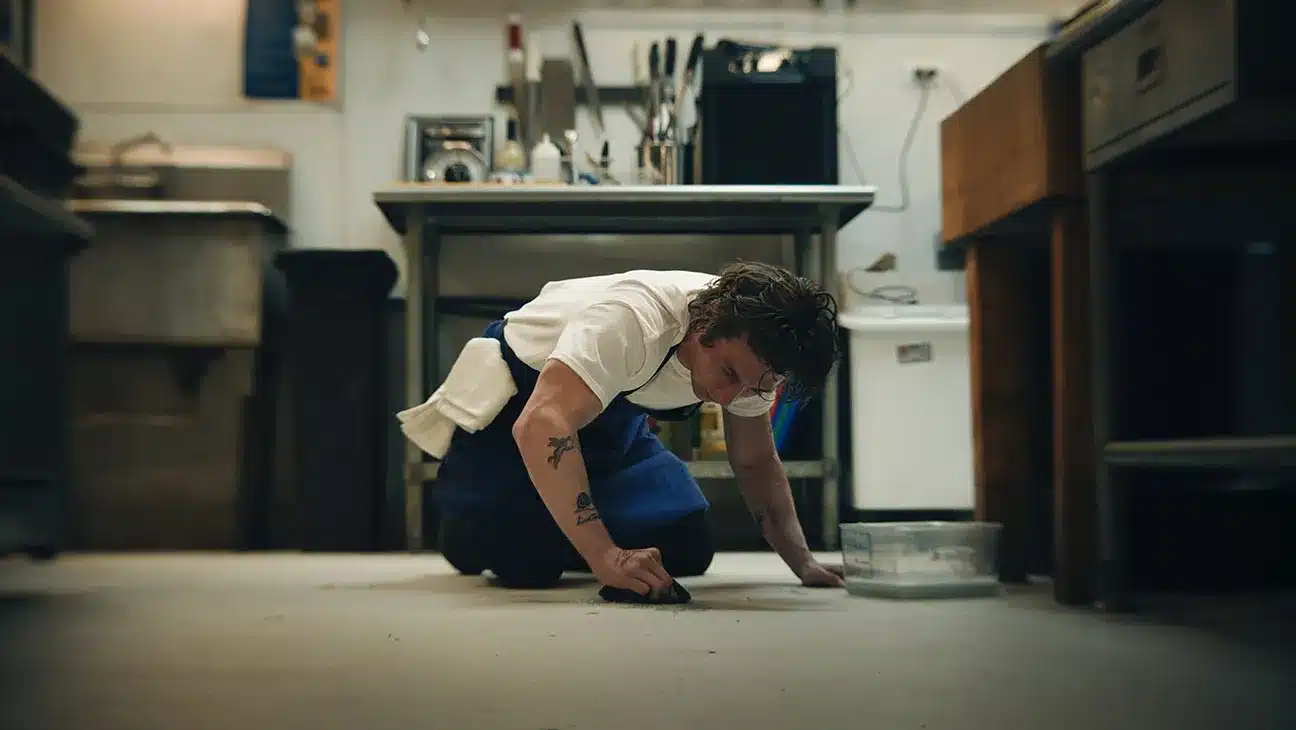
Jeremy Allen White (Carmy) in The Bear
Jeremy Allen White (Carmy) in The Bear
Chef Carmen (Carmy) Berzatto, originally from Chicago, worked in prestigious high-end restaurants all over the world before having to return to his hometown after his older brother Michael (Mikey) commits suicide. He leaves Carmy his beef sandwich restaurant, which is crumbling both physically and financially. Carmy’s life has been a complicated one up until this point, and his brother’s death is the tipping point that makes his psychological distress intensify.
Carmy’s upbringing was shaped by family dysfunction. His mother, Donna, is an alcoholic and was frequently violent, both physically and emotionally, while his father was mostly absent during his childhood. Mikey became Carmy’s father figure and mentor, and they bonded over food and cooking while growing up. It was known among the family members that they could not ask Donna if “she was okay” because she would get extremely upset. For her, this question implied not seeming okay, which was simply unacceptable and almost shameful. In this way, the Berzatto brothers learned that vulnerability was dangerous and internalized their own emotions.
There is a third Berzatto sibling: Natalie (Sugar), the youngest sister. In spite of being deeply affected by the treatment she received from her mom throughout her life, she is determined to put a halt to the cycle and avoid repeating her mother’s mistakes with her own daughter. Sugar personifies resilience in this series. She is the de facto manager of the restaurant and plays an almost matriarchal role there; everyone can turn to her for help and she always has everything under control. This need for control is shared by Carmy, but in a very different way. The chaos that they both experienced at home during their upbringing led them to crave control over their adult lives. Research has shown that uncertainty during childhood affects one’s sense of control over the environment, and that these variables are negatively correlated (Mittal and Griskevicius, 2012). Additionally, a negative correlation between childhood unpredictability and emotional regulation in adulthood has also been observed (Szepsenwol et al., 2022). These findings suggest that unstable caregiving environments early in life can have long-term consequences for emotional processing and coping abilities, explaining why Carmy has not been able to work through this trauma effectively, and the consequences keep piling up. This is also a good explanation for how irritable and aggressive Carmy can get in the kitchen. The anger becomes a cycle in which he repeats the same violent patterns from his past despite his rejection towards them. Problems with emotion regulation are one of the main symptoms of c-PTSD, a traumatic disorder characterized by prolonged exposure to traumatic events rather than an isolated event (Cleveland Clinic, n.d.). This is not a disorder included in the DSM but it is in the ICD-11, and it encompasses all PTSD symptoms plus three additional ones, including emotion regulation issues.
In the final years of his life, Mikey was an alcoholic and addicted to painkillers, but Carmy never knew this until after he died. In fact, they were not on speaking terms when he took his life. This makes Mikey’s death weigh even more heavily on Carmy because he believes that, had he not been absent, his brother might still be alive. They had a feud over Mikey not letting Carmy work at his restaurant with him, which is one of the things that pushed Carmy to want to become an excellent chef: So he could prove to his brother that he was good enough to work with him. He is tormented by the guilt of failing to see how much Mikey was struggling and for losing the time they had left together due to his own pride. At an Al-Anon meeting in Season 1, Carmy says the following when talking about Mikey: “I think it’s very clear that me trying to fix the restaurant was me trying to fix whatever was happening with my brother”. Rather than processing his grief directly, he attempts to cope through bringing order and structure to the restaurant, compensating for the lack of control he had over his brother’s death.
“Rather than processing his grief directly, he attempts to cope through bringing order and structure to the restaurant, compensating for the lack of control he had over his brother’s death.”
Further into the season, Carmy discovers a note his brother left for him in the restaurant, in which Mikey wrote: “I love you dude. Let it rip”. The latter expression, which already carried a sentimental meaning for the brothers, adopts a new poetic resonance in the context of Carmy’s grief. “Let it rip” is a sign for him to loosen his grip on fear and control and accept his pain in order to heal. Regardless of Mikey’s original intent, the message becomes exactly what Carmy has long awaited: A form of permission to feel, which he had never granted himself.
In addition to family trauma, Carmy worked in a toxic environment for many years, where the head chef of the restaurant would constantly tell him that he was no good and he would never amount to anything. This psychological degradation and pressure gave him ulcers, nightmares, and panic attacks. It also pushed him into a burnout cycle, as he relentlessly worked to improve despite already being a great chef, ultimately damaging his self-esteem. Problems with self-identity are the second additional c-PTSD symptom, clearly reflected in his negative self-view and lack of self-esteem.
When Carmy starts working at Mikey’s restaurant after his death, he rejects support from those around him and insists on doing things his way, repeating violent behaviors that his former supervisor did with him, like shouting and dismissing his colleagues’ ideas. This is making the restaurant fail: Carmy fails to work as a true team member because for him work used to be a competition. We see this pride mainly in the first season, but with time, he starts loosening up and seeking support from his friends and family. A critical factor in Carmy’s deterioration while he was away from Chicago was the lack of a support system: No one to provide him with the reassurance that his family misses him, that he’s good at what he does, and that he’s loved. When he comes back, he regains that support.
Richie, Carmy’s cousin who also works at the restaurant, plays a particularly important part in Carmy’s grieving process: He offered the reassurance that even though they were fighting, his brother loved him deeply and that he was not holding any grudge against him when he took his life. This was essential for Carmy to begin to move on and not blame himself anymore for Mikey’s passing. Sydney, Carmy’s sous-chef at the new restaurant, is another character that helped Carmy’s healing process. In a way, Sydney reminded Carmy of himself when he started, ambitious and full of ideas, and this makes him realize he is not suited for his job anymore; she has the spark that he lost. At the same time, Sydney helped Carmy realize that the kitchen can be a safe space, and that it does not have to entail shouting, anxiety, and discouraging pressure. A bidirectional relationship between social support and trauma has been found in research: While social support reduces PTSD symptoms, trauma could also simultaneously damage social relationships (Liu et al., 2022), through rejection of help, aggressive behavior, etc. This pattern is evident in Carmy’s repeated conflicts, including Sydney’s temporary resignation and frequent arguments with Richie. Having problems with relational capacities is the third additional c-PTSD symptom.
“'Let it rip' is a sign for him to loosen his grip on fear and control and accept his pain in order to heal.”
Carmy’s different sources of trauma do not work independently from each other; they are layered on top of each other and they relate in many ways. As mentioned throughout this article, Carmy displays the three main c-PTSD symptoms: problems with emotion regulation, self-identity and relational capacities. Other classic PTSD symptoms he shows are having flashbacks or nightmares of the traumatic events, problems with concentration and dissociation — he dissociated while cooking multiple times, risking fires in the kitchen —, and persistent cognitions about the cause or consequences of the traumatic events that lead the individual to blame himself, particularly about Mikey’s death.
For Carmy, the job is not about passion or about the emotion conveyed to the diner through the food anymore, but about perfection. The same perfection he was led to believe he could never achieve at his previous workplace. The same perfection he believed would make his brother allow him to work with him. This persistent pursuit of perfection is also intertwined with his need to exert control over his environment.
His need for control created through his relationship with his mom, his abusive work experience where he was fed the idea that he would never be a good chef, the constant reminder of his brother’s rejection towards him wanting to work at his restaurant, and the secondary symptoms these entail all contribute to the dysfunctional dynamic Carmy brings to the kitchen. His inability to cope with all of this is also what is killing his passion for cooking: He associates the kitchen with all of his failures and struggles instead of with his outstanding gift and the love he used to have for cooking. The kitchen used to be a place where he thrived and felt safe to grow, but now it has become destructive for him.
In the most recent season, Carmy begins to make amends with not only the lack of enjoyment he feels towards his work, but also with the causes of his despair: He receives an apology from his mom, he starts letting go of his feud with Mikey, and he confronts his former boss about how much he hurt him. Through all of the support he received, he was able to reach a point where he can acknowledge his trauma and its impact without being defined by it.
The Bear presents itself as a series about cooking, but unexpectedly offers a complex portrayal of the deterioration of mental health as a consequence of trauma. The series is not about the end point of resolution or unrealistic absolute recovery, but about showing the raw and relentless struggle of living with trauma. The Bear is about the journey. About showing the panic attacks behind the restaurant. About the flashbacks. About holding and letting go of grudges against others, as well as against oneself. About knowing that life is a little easier if you are surrounded by people who love you. About the hard path toward acceptance of those things that cannot be undone and the blood, sweat, and tears lost along the way.
References
– Complex PTSD. (n.d.). Cleveland Clinic. Retrieved 6 January 2026, from https://my.clevelandclinic.org/health/diseases/24881-cptsd-complex-ptsd
– Liu, S. Y., Li, J., Leon, L. F., Schwarzer, R., & Cone, J. E. (2022). The bidirectional relationship between posttraumatic stress symptoms and social support in a 9/11-exposed cohort: A longitudinal cross-lagged analysis. International Journal of Environmental Research and Public Health, 19(5), 2604. https://doi.org/10.3390/ijerph19052604
– Mittal, C., & Griskevicius, V. (2014). Sense of control under uncertainty depends on people’s childhood environment: A life history theory approach. Journal of Personality and Social Psychology, 107(4), 621–637. https://doi.org/10.1037/a0037398
– Storer, C. (Creator). (2022– ). The Bear [TV series]. FX
– Szepsenwol, O., Simpson, J. A., Griskevicius, V., Zamir, O., Young, E. S., Shoshani, A., & Doron, G. (2022). The effects of childhood unpredictability and harshness on emotional control and relationship quality: A life history perspective. Development and Psychopathology, 34(2), 607–620. https://doi.org/10.1017/S0954579421001371
Chef Carmen (Carmy) Berzatto, originally from Chicago, worked in prestigious high-end restaurants all over the world before having to return to his hometown after his older brother Michael (Mikey) commits suicide. He leaves Carmy his beef sandwich restaurant, which is crumbling both physically and financially. Carmy’s life has been a complicated one up until this point, and his brother’s death is the tipping point that makes his psychological distress intensify.
Carmy’s upbringing was shaped by family dysfunction. His mother, Donna, is an alcoholic and was frequently violent, both physically and emotionally, while his father was mostly absent during his childhood. Mikey became Carmy’s father figure and mentor, and they bonded over food and cooking while growing up. It was known among the family members that they could not ask Donna if “she was okay” because she would get extremely upset. For her, this question implied not seeming okay, which was simply unacceptable and almost shameful. In this way, the Berzatto brothers learned that vulnerability was dangerous and internalized their own emotions.
There is a third Berzatto sibling: Natalie (Sugar), the youngest sister. In spite of being deeply affected by the treatment she received from her mom throughout her life, she is determined to put a halt to the cycle and avoid repeating her mother’s mistakes with her own daughter. Sugar personifies resilience in this series. She is the de facto manager of the restaurant and plays an almost matriarchal role there; everyone can turn to her for help and she always has everything under control. This need for control is shared by Carmy, but in a very different way. The chaos that they both experienced at home during their upbringing led them to crave control over their adult lives. Research has shown that uncertainty during childhood affects one’s sense of control over the environment, and that these variables are negatively correlated (Mittal and Griskevicius, 2012). Additionally, a negative correlation between childhood unpredictability and emotional regulation in adulthood has also been observed (Szepsenwol et al., 2022). These findings suggest that unstable caregiving environments early in life can have long-term consequences for emotional processing and coping abilities, explaining why Carmy has not been able to work through this trauma effectively, and the consequences keep piling up. This is also a good explanation for how irritable and aggressive Carmy can get in the kitchen. The anger becomes a cycle in which he repeats the same violent patterns from his past despite his rejection towards them. Problems with emotion regulation are one of the main symptoms of c-PTSD, a traumatic disorder characterized by prolonged exposure to traumatic events rather than an isolated event (Cleveland Clinic, n.d.). This is not a disorder included in the DSM but it is in the ICD-11, and it encompasses all PTSD symptoms plus three additional ones, including emotion regulation issues.
In the final years of his life, Mikey was an alcoholic and addicted to painkillers, but Carmy never knew this until after he died. In fact, they were not on speaking terms when he took his life. This makes Mikey’s death weigh even more heavily on Carmy because he believes that, had he not been absent, his brother might still be alive. They had a feud over Mikey not letting Carmy work at his restaurant with him, which is one of the things that pushed Carmy to want to become an excellent chef: So he could prove to his brother that he was good enough to work with him. He is tormented by the guilt of failing to see how much Mikey was struggling and for losing the time they had left together due to his own pride. At an Al-Anon meeting in Season 1, Carmy says the following when talking about Mikey: “I think it’s very clear that me trying to fix the restaurant was me trying to fix whatever was happening with my brother”. Rather than processing his grief directly, he attempts to cope through bringing order and structure to the restaurant, compensating for the lack of control he had over his brother’s death.
“Rather than processing his grief directly, he attempts to cope through bringing order and structure to the restaurant, compensating for the lack of control he had over his brother’s death.”
Further into the season, Carmy discovers a note his brother left for him in the restaurant, in which Mikey wrote: “I love you dude. Let it rip”. The latter expression, which already carried a sentimental meaning for the brothers, adopts a new poetic resonance in the context of Carmy’s grief. “Let it rip” is a sign for him to loosen his grip on fear and control and accept his pain in order to heal. Regardless of Mikey’s original intent, the message becomes exactly what Carmy has long awaited: A form of permission to feel, which he had never granted himself.
In addition to family trauma, Carmy worked in a toxic environment for many years, where the head chef of the restaurant would constantly tell him that he was no good and he would never amount to anything. This psychological degradation and pressure gave him ulcers, nightmares, and panic attacks. It also pushed him into a burnout cycle, as he relentlessly worked to improve despite already being a great chef, ultimately damaging his self-esteem. Problems with self-identity are the second additional c-PTSD symptom, clearly reflected in his negative self-view and lack of self-esteem.
When Carmy starts working at Mikey’s restaurant after his death, he rejects support from those around him and insists on doing things his way, repeating violent behaviors that his former supervisor did with him, like shouting and dismissing his colleagues’ ideas. This is making the restaurant fail: Carmy fails to work as a true team member because for him work used to be a competition. We see this pride mainly in the first season, but with time, he starts loosening up and seeking support from his friends and family. A critical factor in Carmy’s deterioration while he was away from Chicago was the lack of a support system: No one to provide him with the reassurance that his family misses him, that he’s good at what he does, and that he’s loved. When he comes back, he regains that support.
Richie, Carmy’s cousin who also works at the restaurant, plays a particularly important part in Carmy’s grieving process: He offered the reassurance that even though they were fighting, his brother loved him deeply and that he was not holding any grudge against him when he took his life. This was essential for Carmy to begin to move on and not blame himself anymore for Mikey’s passing. Sydney, Carmy’s sous-chef at the new restaurant, is another character that helped Carmy’s healing process. In a way, Sydney reminded Carmy of himself when he started, ambitious and full of ideas, and this makes him realize he is not suited for his job anymore; she has the spark that he lost. At the same time, Sydney helped Carmy realize that the kitchen can be a safe space, and that it does not have to entail shouting, anxiety, and discouraging pressure. A bidirectional relationship between social support and trauma has been found in research: While social support reduces PTSD symptoms, trauma could also simultaneously damage social relationships (Liu et al., 2022), through rejection of help, aggressive behavior, etc. This pattern is evident in Carmy’s repeated conflicts, including Sydney’s temporary resignation and frequent arguments with Richie. Having problems with relational capacities is the third additional c-PTSD symptom.
“'Let it rip' is a sign for him to loosen his grip on fear and control and accept his pain in order to heal.”
Carmy’s different sources of trauma do not work independently from each other; they are layered on top of each other and they relate in many ways. As mentioned throughout this article, Carmy displays the three main c-PTSD symptoms: problems with emotion regulation, self-identity and relational capacities. Other classic PTSD symptoms he shows are having flashbacks or nightmares of the traumatic events, problems with concentration and dissociation — he dissociated while cooking multiple times, risking fires in the kitchen —, and persistent cognitions about the cause or consequences of the traumatic events that lead the individual to blame himself, particularly about Mikey’s death.
For Carmy, the job is not about passion or about the emotion conveyed to the diner through the food anymore, but about perfection. The same perfection he was led to believe he could never achieve at his previous workplace. The same perfection he believed would make his brother allow him to work with him. This persistent pursuit of perfection is also intertwined with his need to exert control over his environment.
His need for control created through his relationship with his mom, his abusive work experience where he was fed the idea that he would never be a good chef, the constant reminder of his brother’s rejection towards him wanting to work at his restaurant, and the secondary symptoms these entail all contribute to the dysfunctional dynamic Carmy brings to the kitchen. His inability to cope with all of this is also what is killing his passion for cooking: He associates the kitchen with all of his failures and struggles instead of with his outstanding gift and the love he used to have for cooking. The kitchen used to be a place where he thrived and felt safe to grow, but now it has become destructive for him.
In the most recent season, Carmy begins to make amends with not only the lack of enjoyment he feels towards his work, but also with the causes of his despair: He receives an apology from his mom, he starts letting go of his feud with Mikey, and he confronts his former boss about how much he hurt him. Through all of the support he received, he was able to reach a point where he can acknowledge his trauma and its impact without being defined by it.
The Bear presents itself as a series about cooking, but unexpectedly offers a complex portrayal of the deterioration of mental health as a consequence of trauma. The series is not about the end point of resolution or unrealistic absolute recovery, but about showing the raw and relentless struggle of living with trauma. The Bear is about the journey. About showing the panic attacks behind the restaurant. About the flashbacks. About holding and letting go of grudges against others, as well as against oneself. About knowing that life is a little easier if you are surrounded by people who love you. About the hard path toward acceptance of those things that cannot be undone and the blood, sweat, and tears lost along the way.