Dear Readers,
Throughout our lives, we encounter people from all walks of life. Those who are aligned with us in ways we never thought possible, those incompatible to us to the point of conflict, and everyone in between. While these interactions change us and those around us, they can also teach us about the greater systems we contribute to, helping us understand who we are at our core and how we present ourselves to the world. In Spiegeloog 442: Character, discover more about yourself, those around you, and where the lines between them blur.
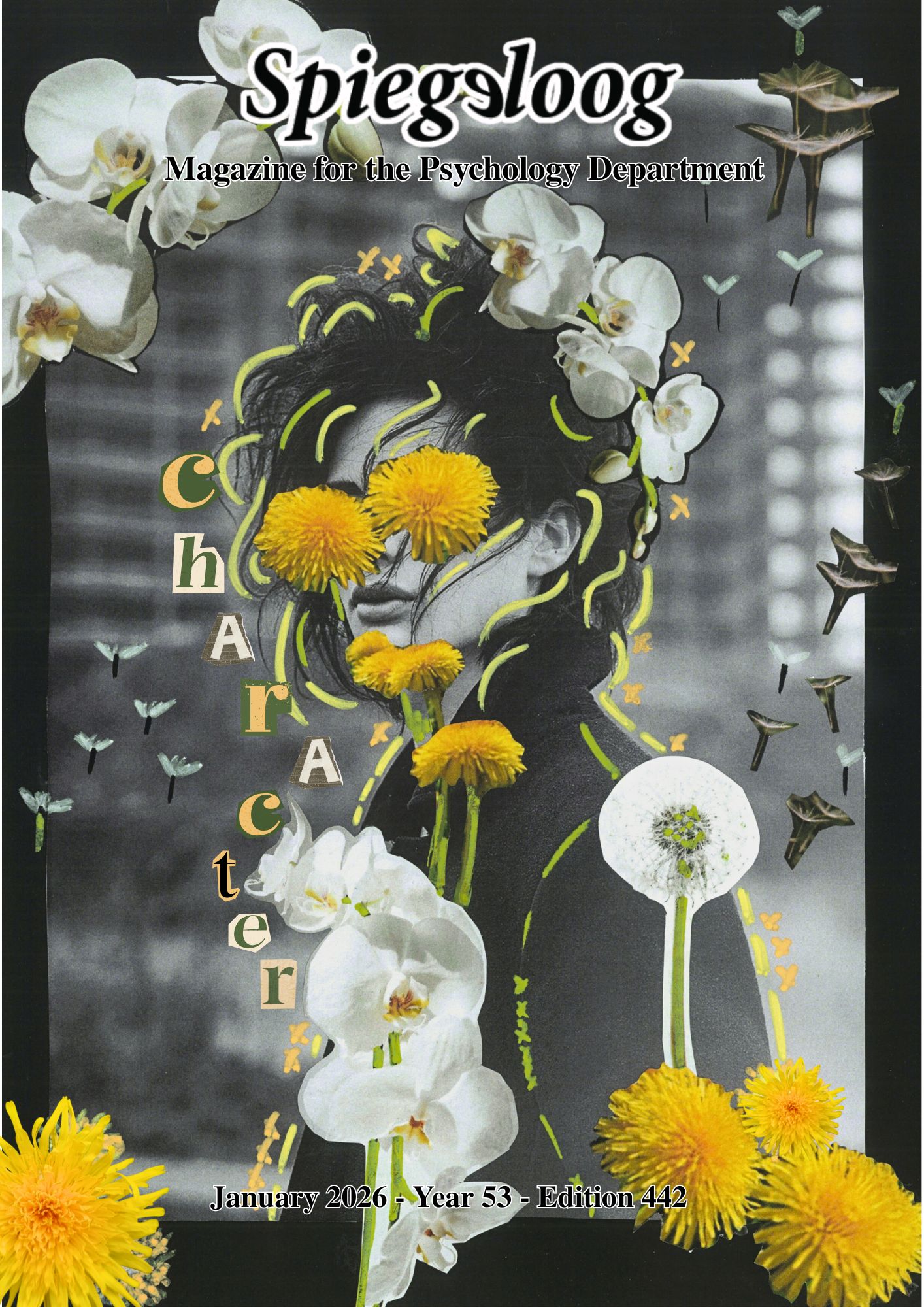
Cover by Jules Kotowicz
As an appetizer, some Words to Start. Then, Laura begins in earnest with an analysis of The Bear and its portrayal of PTSD in its main character, Carmy. Varsha follows suit by looking at the all too common mischaracterization of therapists in popular media, after which Barnaba reviews the good, the bad, and the solitary in Susanna Clarke’s Piranesi for this issue’s Tabula Rasa. Alex then takes a more overarching view of media by looking at how nations are represented through their stories, followed by Izzy’s even grander piece on cosmic guidance, exploring how and why we are so keen on giving nature intention. Going from broad to specific, Aliki puts Machiavellianism under the microscope—is it as bad as we make it out to be, or is it simply one of many adaptation mechanisms in today’s society? Ask the Expert answers a different question from one UvA employee to another, and Manu’s essay on power takes a look at the imaginal, individualism, and how we can take back control from the systems we have built up. Finally, Marie takes a deep dive into the personification of AI and the risks associated with ChatGPT being your best friend, and Zhen closes out the issue with his article on Hyperscanning and a look inside the Human+ lab.
We hope you had a great holiday, and thank you for reading Spiegeloog!
Barnaba & Jules
Dear Readers,
Throughout our lives, we encounter people from all walks of life. Those who are aligned with us in ways we never thought possible, those incompatible to us to the point of conflict, and everyone in between. While these interactions change us and those around us, they can also teach us about the greater systems we contribute to, helping us understand who we are at our core and how we present ourselves to the world. In Spiegeloog 442: Character, discover more about yourself, those around you, and where the lines between them blur.
Cover by Nina Kollof
As an appetizer, some Words to Start. Then, Laura begins in earnest with an analysis of The Bear and its portrayal of PTSD in its main character, Carmy. Varsha follows suit by looking at the all too common mischaracterization of therapists in popular media, after which Barnaba reviews the good, the bad, and the solitary in Susanna Clarke’s Piranesi for this issue’s Tabula Rasa. Alex then takes a more overarching view of media by looking at how nations are represented through their stories, followed by Izzy’s even grander piece on cosmic guidance, exploring how and why we are so keen on giving nature intention. Going from broad to specific, Aliki puts Machiavellianism under the microscope—is it as bad as we make it out to be, or is it simply one of many adaptation mechanisms in today’s society? Ask the Expert answers a different question from one UvA employee to another, and Manu’s essay on power takes a look at the imaginal, individualism, and how we can take back control from the systems we have built up. Finally, Marie takes a deep dive into the personification of AI and the risks associated with ChatGPT being your best friend, and Zhen closes out the issue with his article on Hyperscanning and a look inside the Human+ lab.
We hope you had a great holiday, and thank you for reading Spiegeloog!
Barnaba & Jules