
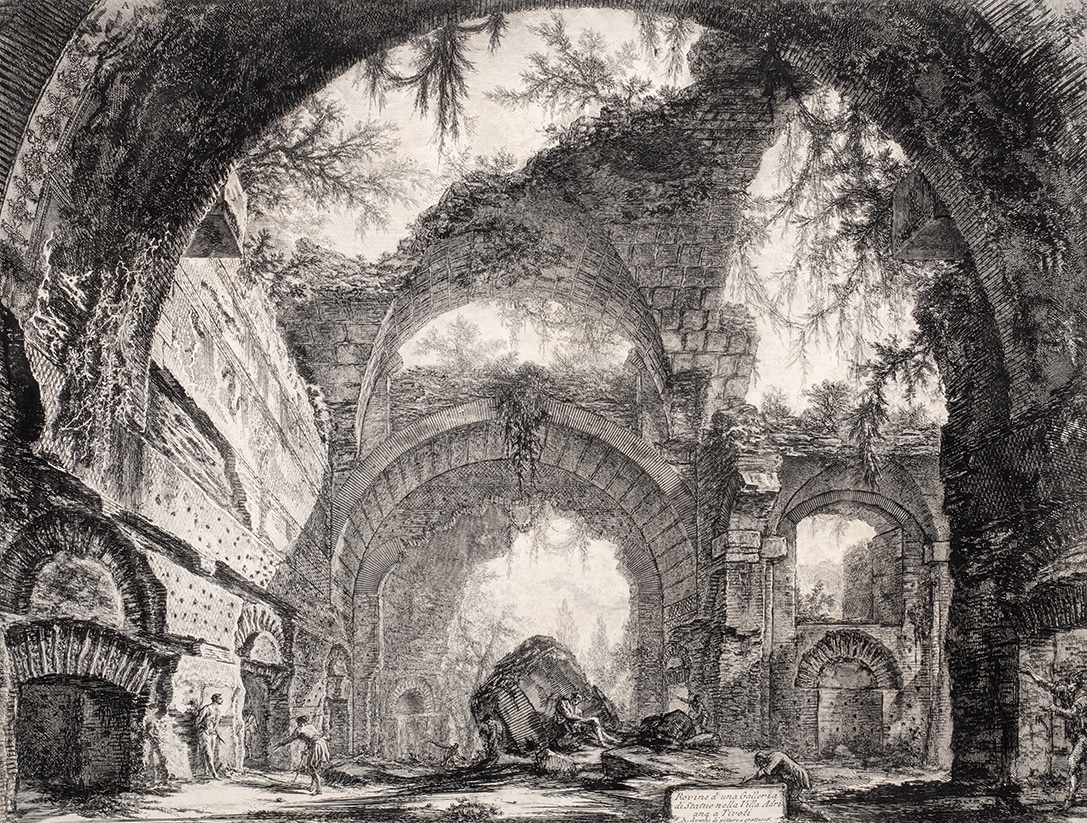
Etching by Giovanni Battista Piranesi
In the House there are immense Halls stretching in every direction. The sound of the Tides comes and goes, distant. Save for a few animals, the statues that populate the Halls, and the Other, Piranesi is alone.
This is the world of Susanna Clarke’s novel Piranesi. Named after Giovanni Battista Piranesi, an Italian architect known for his etchings of fictitious prisons, the story is told through entries of the titular character Piranesi’s life and exploration of the mysterious structure he inhabits, the House. His record of daily activities and findings on his quest to find the “Great and Secret Knowledge” with the Other, an enigmatic man who seems to know more than he lets on, unravels as he discovers more about the House, the Other, and himself.
Piranesi is a contemplative story, one which has its main character take their time the way we rarely do in our own lives. Countless pages are spent taking in Piranesi’s surroundings or carrying out mundane tasks, and his wonder and reverence for the House adds a mystic quality to each statue, encounter, and strange occurrence he comes across. You want to find out why he calls them Halls and not halls and why he has names for each set of human bones, but there is also an infectious quality to his joy—the half-child, half-scholar approach he takes to researching the House.
The House itself has an almost Lovecraftian nature to it; its vastness is infinite and so are its statues, and each Hall brings with it new and unpredictable elements. The benefits of the notebook-entry style also show themselves in Piranesi’s exploration of the House: Because his viewpoint is the only one available, the emptiness of the House is amplified when room after room passes without so much as a whisper, while the fear of getting lost is abated by his absolute trust in the House’s benevolence. If to Piranesi the House is alive—another character in the story—then it is so for the reader as well.
The weakest part of the novel is the plot, mainly from lack of trying. The initially compelling mystery that begins to take shape through small inconsistencies in Piranesi’s memory soon takes the back seat, usually feeling like a byproduct of Piranesi’s writings rather than their focal point. This leads to a narrative structure that is sometimes disjointed, with tranquil meditations taking the suspense away from the important reveals that precede them. The journaling style also doesn’t do any favors for the book’s tension. The past-tense narration of every event takes away any illusion of danger there might have been, and the need to account for writing time often means there are breaks of at least a day between important events. While the climax answers the story’s questions somewhat satisfyingly, in clearing up some of the novel’s mysteries it also inadvertently detracts from the atmosphere it spends so much effort trying—and succeeding—to build up.
The focus on character that Piranesi takes makes it a book with endless room for discussion. I read Piranesi for my book club (which, like popcorn for movies, immediately adds half a star to the rating), and the analysis of the story’s purpose took several forms. From talks of PTSD and Dissociative Identity Disorder to a theory that the entire novel is an allegory for trauma that holds up surprisingly well, Piranesi is a book which leaves much to the discretion of its readers. A lot is left unsaid on purpose, and it is up to the audience to make what they will of the pieces that remain.
Piranesi is often slow but rarely boring. It misses the opportunity to feature a great atmosphere and a great mystery, but the former makes it enjoyable the whole way through. It questions what makes a person who they are, who we become without our experiences, and the division between solitude and loneliness. To reach the House, one must “return to the last place in which one had stood before the iron hand of modern rationality gripped one’s mind.”
Where was that for you?
Piranesi is in book stores or online starting at €7.99.
In the House there are immense Halls stretching in every direction. The sound of the Tides comes and goes, distant. Save for a few animals, the statues that populate the Halls, and the Other, Piranesi is alone.
This is the world of Susanna Clarke’s novel Piranesi. Named after Giovanni Battista Piranesi, an Italian architect known for his etchings of fictitious prisons, the story is told through entries of the titular character Piranesi’s life and exploration of the mysterious structure he inhabits, the House. His record of daily activities and findings on his quest to find the “Great and Secret Knowledge” with the Other, an enigmatic man who seems to know more than he lets on, unravels as he discovers more about the House, the Other, and himself.
Piranesi is a contemplative story, one which has its main character take their time the way we rarely do in our own lives. Countless pages are spent taking in Piranesi’s surroundings or carrying out mundane tasks, and his wonder and reverence for the House adds a mystic quality to each statue, encounter, and strange occurrence he comes across. You want to find out why he calls them Halls and not halls and why he has names for each set of human bones, but there is also an infectious quality to his joy—the half-child, half-scholar approach he takes to researching the House.
The House itself has an almost Lovecraftian nature to it; its vastness is infinite and so are its statues, and each Hall brings with it new and unpredictable elements. The benefits of the notebook-entry style also show themselves in Piranesi’s exploration of the House: Because his viewpoint is the only one available, the emptiness of the House is amplified when room after room passes without so much as a whisper, while the fear of getting lost is abated by his absolute trust in the House’s benevolence. If to Piranesi the House is alive—another character in the story—then it is so for the reader as well.
The weakest part of the novel is the plot, mainly from lack of trying. The initially compelling mystery that begins to take shape through small inconsistencies in Piranesi’s memory soon takes the back seat, usually feeling like a byproduct of Piranesi’s writings rather than their focal point. This leads to a narrative structure that is sometimes disjointed, with tranquil meditations taking the suspense away from the important reveals that precede them. The journaling style also doesn’t do any favors for the book’s tension. The past-tense narration of every event takes away any illusion of danger there might have been, and the need to account for writing time often means there are breaks of at least a day between important events. While the climax answers the story’s questions somewhat satisfyingly, in clearing up some of the novel’s mysteries it also inadvertently detracts from the atmosphere it spends so much effort trying—and succeeding—to build up.
The focus on character that Piranesi takes makes it a book with endless room for discussion. I read Piranesi for my book club (which, like popcorn for movies, immediately adds half a star to the rating), and the analysis of the story’s purpose took several forms. From talks of PTSD and Dissociative Identity Disorder to a theory that the entire novel is an allegory for trauma that holds up surprisingly well, Piranesi is a book which leaves much to the discretion of its readers. A lot is left unsaid on purpose, and it is up to the audience to make what they will of the pieces that remain.
Piranesi is often slow but rarely boring. It misses the opportunity to feature a great atmosphere and a great mystery, but the former makes it enjoyable the whole way through. It questions what makes a person who they are, who we become without our experiences, and the division between solitude and loneliness.
To reach the House, one must “return to the last place in which one had stood before the iron hand of modern rationality gripped one’s mind.” Where was that for you?
Piranesi is in book stores or online starting at €7.99.