Fifty years ago, a Spiegeloog writer had strong things to say about the of of psychology parties from one venue to another. As a glimpse into the life of a psychology student back then, we translated that article into English.
Fifty years ago, a Spiegeloog writer had strong things to say about the of of psychology parties from one venue to another. As a glimpse into the life of a psychology student back then, we translated that article into English.
No one needs to mourn the extinction of most of the so-called student life’s traditions. Certainly, Propria Cures still lingers (albeit languishingly), and in places like Hoppe and D’Oude Berberg, a few examples of “The Student” can still be admired. With the disappearance of the rich kids’ monopoly on university, a new culture emerged among the students: less isolated from peers, less religiously inclined, and more influenced by the political and cultural developments of the sixties than by the heritage of the upper middle class, as embodied by the associations. In short, a development as necessary as it is welcome.
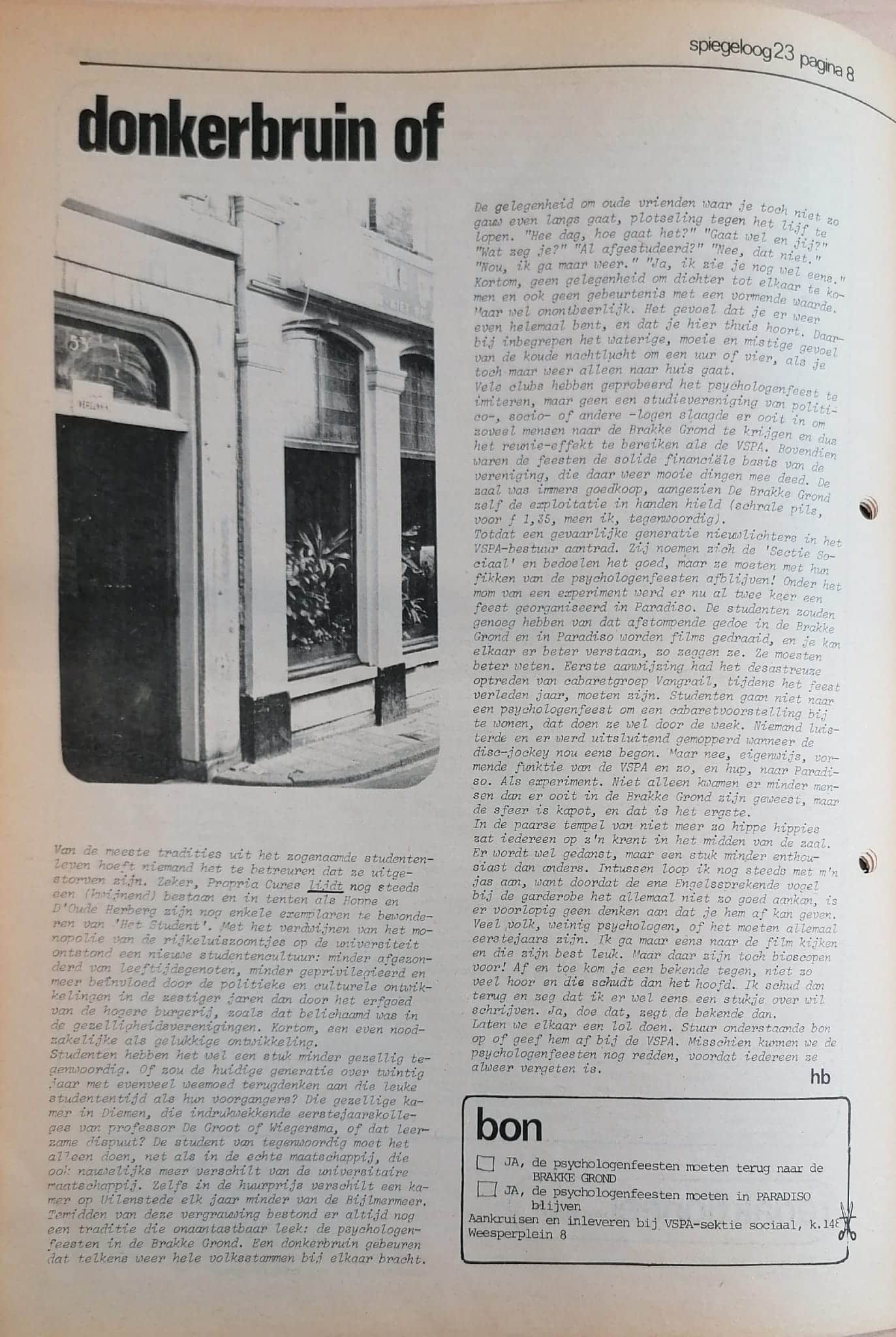
Students have it a lot less fun these days. Or will the current generation, twenty years from now, look back on those fun student days with as much nostalgia as their predecessors? That cozy room in Diemen, those impressive first-year lectures by Professor De Groot or Wiegersma, or that informative fraternity? Today’s student has to do it alone, just like in real society, which hardly differs from university society anymore. Even the rent for a room at Uilenstede differs less and less each year from the Bijlmermeer. Amidst this graying of society, there was always a seemingly untouchable tradition: the psychology parties at De Brakke Grond. A dark brown event that repeatedly brought together entire tribes of people.
The opportunity to suddenly run into old friends you wouldn’t normally visit.
“Hey, how are you?”
“I’m fine, and you?”
“What did you say?”
“Did you graduate yet?”
“No, not yet.”
“Well, I’m off.”
“Yeah, I’ll see you around.”
In short, no opportunity to get closer, and no event with any formative value either. But indispensable nonetheless. The feeling that you’re actually whole again, that you belong here. Including the watery, tired, and misty feeling of the cold night air at four in the morning, when you’re going home alone again.
“Every now and then you run into someone you know—not often, mind you—and they shake their head.”
Many clubs have tried to imitate the psychology party, but no study association of political science, sociology, or other science has ever succeeded in attracting as many students to De Brakke Grond and thus achieving the reunion effect as the VSPA. Moreover, the parties provided a solid financial basis for the association, which in turn used it to do wonderful things. After all, the venue was cheap, since De Brakke Grond managed the operation itself (schrale pils, for 1.35 guilders, I think, these days).
Until a dangerous generation of newcomers joined the VSPA board. They call themselves the ‘Social Section’ and mean well, but they should keep their hands off the psychology parties! Under the guise of an experiment, a party has now been organised twice in Paradiso. The students have had enough of the dull fuss in the Brakke Grond and films are shown in Paradiso, and you can understand each other better there, they say. They should have known better. The first clue should have been the disastrous performance of cabaret group Bangrail during last year’s party. Students don’t go to a psychology party to attend a cabaret show; they do that during the week. No one listened, and there was only grumbling about when the DJ would finally start. But no, stubborn, formative function of the VSPA and all, and off we went to Paradiso. As an experiment. Not only did fewer people show up than ever had at De Brakke Grond, but the atmosphere was ruined, and that’s the worst part.
In the purple temple of not-so-hip-anymore hippies, everyone was sitting on their asses in the middle of the room. There was dancing, but far less enthusiastically than usual. Meanwhile I’m still walking around with my jacket on, since because some English-speaking bird at the wardrobe couldn’t do anything very well, I can’t even begin to think about handing it in.
Many people, few psychologists, unless they are all first-year students. I end up going to watch the movie, and it’s quite good. But that’s what cinemas are for! Every now and then you run into someone you know—not often, mind you—and they shake their head. I shake my head back and say I’d like to write a piece about it. “Yes, go ahead,” they say. Let’s do each other a favor. Send the coupon below or drop it off at the VSPA. Maybe we can still save the psychology parties before everyone forgets about them.
“A new wind is blowing through the student world. One no longer thick with the smell of beer, sweat, smoke, and engaged talk.”
What a sense of nostalgia comes over some people now that the psychology festivals are in danger of disappearing from the Brakke Grond for good. These people think it’s stupid that, in their opinion, a lot of people’s tradition-based expectation of a perennially identical party is being broken. Are these people really victims of the tiresome innovation drive of younger students? Of course. Because what is the case?
The fresh-anew students of yesteryear have partied at De Brakke Grond for years. And what are we even talking about now! The days when everyone knew everyone in the subfaculty or got to know them at a psychology party are over. In my first year, I came with four hundred others to fill the box even more. By high school I had already gotten used to large crowds. I still don’t know all the classmates who stayed. So the whole experience at De Brakke Grond, which mainly involves crowds, isn’t so appealing anymore.
And besides. Every time the same thing. Defended by those ostentatious bearded men, their mouths full of politics, opposition, and leftism. Culture, no way. Has no one noticed that something like Crea gathers a lot of people?
A new wind is blowing through the student world. One no longer thick with the smell of beer, sweat, smoke, and engaged talk.
When I first came to De Brakke Grond, I noticed it. Like: now I’m really here. In that flashy student world. But really, that’s over. That naturally gives a lot of people a bit of a grim, nervous feeling. A bit of security they’ve held on to over the years. The tradition. Gone. Parties at De Brakke Grond are doomed to immutability anyway. No live music group is allowed in the theater hall. So they’ll always end up in the other room. Then, as a half-hearted competitor, there’s a record player in the hall opposite. Swinging everywhere. Busy everywhere. Very festive, of course. But if that’s all there is to it… I think there are other things that go into a party.
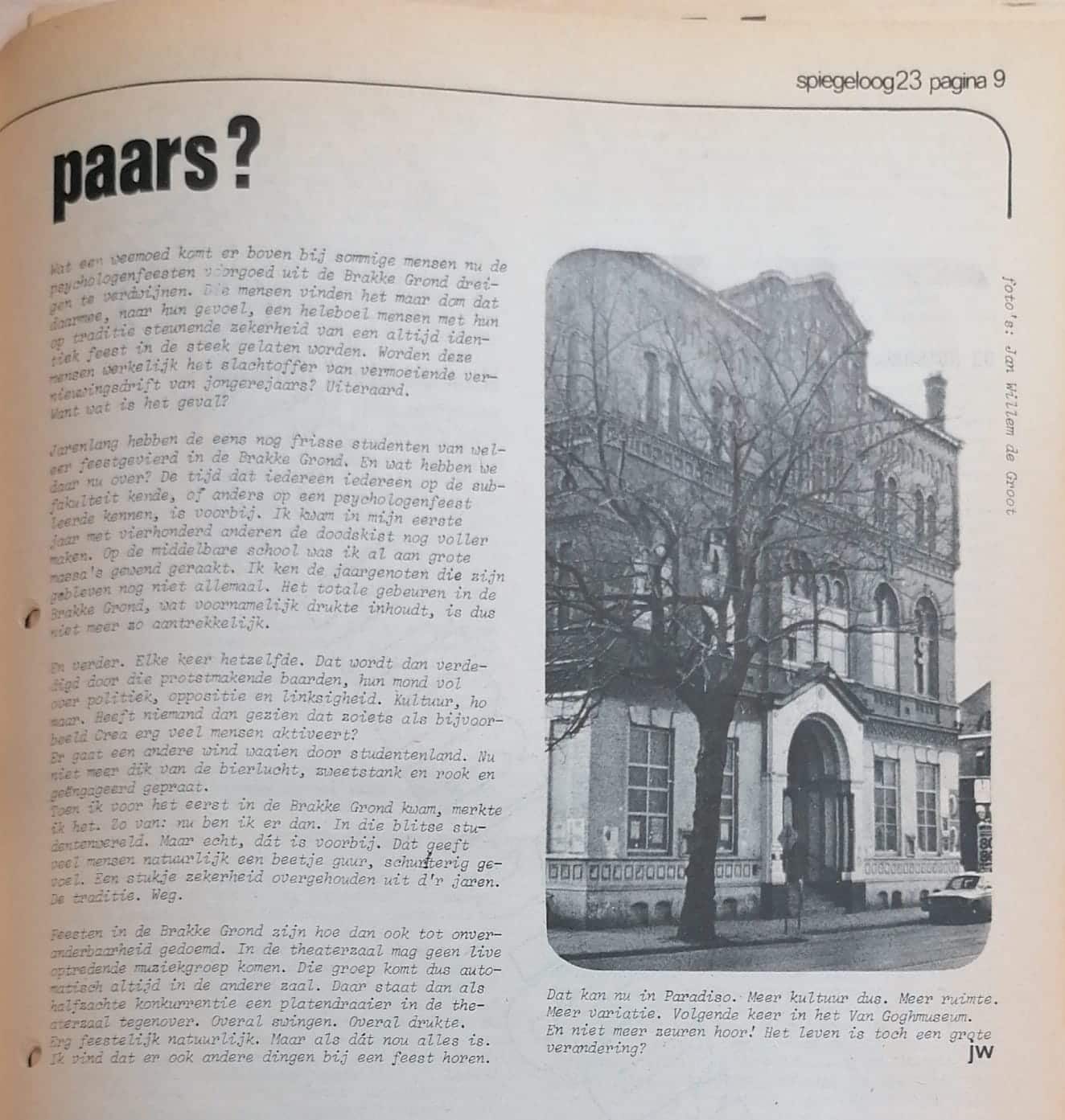
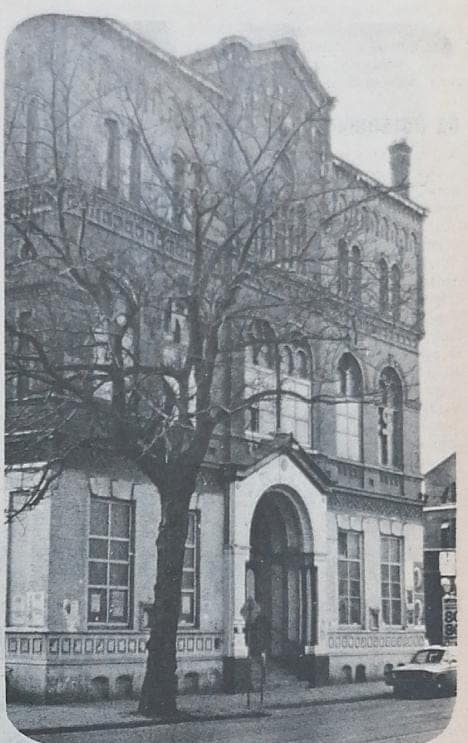
That’s possible now at Paradiso. More culture. More space. More variety. Next time at the Van Gogh Museum. And no more whining! Life is one big change, isn’t it?
No one needs to mourn the extinction of most of the so-called student life’s traditions. Certainly, Propria Cures still lingers (albeit languishingly), and in places like Hoppe and D’Oude Berberg, a few examples of “The Student” can still be admired. With the disappearance of the rich kids’ monopoly on university, a new culture emerged among the students: less isolated from peers, less religiously inclined, and more influenced by the political and cultural developments of the sixties than by the heritage of the upper middle class, as embodied by the associations. In short, a development as necessary as it is welcome.
Students have it a lot less fun these days. Or will the current generation, twenty years from now, look back on those fun student days with as much nostalgia as their predecessors? That cozy room in Diemen, those impressive first-year lectures by Professor De Groot or Wiegersma, or that informative fraternity? Today’s student has to do it alone, just like in real society, which hardly differs from university society anymore. Even the rent for a room at Uilenstede differs less and less each year from the Bijlmermeer. Amidst this graying of society, there was always a seemingly untouchable tradition: the psychology parties at De Brakke Grond. A dark brown event that repeatedly brought together entire tribes of people.
The opportunity to suddenly run into old friends you wouldn’t normally visit.
“Hey, how are you?”
“I’m fine, and you?”
“What did you say?”
“Did you graduate yet?”
“No, not yet.”
“Well, I’m off.”
“Yeah, I’ll see you around.”
In short, no opportunity to get closer, and no event with any formative value either. But indispensable nonetheless. The feeling that you’re actually whole again, that you belong here. Including the watery, tired, and misty feeling of the cold night air at four in the morning, when you’re going home alone again.
“Every now and then you run into someone you know—not often, mind you—and they shake their head.”
Many clubs have tried to imitate the psychology party, but no study association of political science, sociology, or other science has ever succeeded in attracting as many students to De Brakke Grond and thus achieving the reunion effect as the VSPA. Moreover, the parties provided a solid financial basis for the association, which in turn used it to do wonderful things. After all, the venue was cheap, since De Brakke Grond managed the operation itself (schrale pils, for 1.35 guilders, I think, these days).
Until a dangerous generation of newcomers joined the VSPA board. They call themselves the ‘Social Section’ and mean well, but they should keep their hands off the psychology parties! Under the guise of an experiment, a party has now been organised twice in Paradiso. The students have had enough of the dull fuss in the Brakke Grond and films are shown in Paradiso, and you can understand each other better there, they say. They should have known better. The first clue should have been the disastrous performance of cabaret group Bangrail during last year’s party. Students don’t go to a psychology party to attend a cabaret show; they do that during the week. No one listened, and there was only grumbling about when the DJ would finally start. But no, stubborn, formative function of the VSPA and all, and off we went to Paradiso. As an experiment. Not only did fewer people show up than ever had at De Brakke Grond, but the atmosphere was ruined, and that’s the worst part.
In the purple temple of not-so-hip-anymore hippies, everyone was sitting on their asses in the middle of the room. There was dancing, but far less enthusiastically than usual. Meanwhile I’m still walking around with my jacket on, since because some English-speaking bird at the wardrobe couldn’t do anything very well, I can’t even begin to think about handing it in.
Many people, few psychologists, unless they are all first-year students. I end up going to watch the movie, and it’s quite good. But that’s what cinemas are for! Every now and then you run into someone you know—not often, mind you—and they shake their head. I shake my head back and say I’d like to write a piece about it. “Yes, go ahead,” they say. Let’s do each other a favor. Send the coupon below or drop it off at the VSPA. Maybe we can still save the psychology parties before everyone forgets about them.
“A new wind is blowing through the student world. One no longer thick with the smell of beer, sweat, smoke, and engaged talk.”
What a sense of nostalgia comes over some people now that the psychology festivals are in danger of disappearing from the Brakke Grond for good. These people think it’s stupid that, in their opinion, a lot of people’s tradition-based expectation of a perennially identical party is being broken. Are these people really victims of the tiresome innovation drive of younger students? Of course. Because what is the case?
The fresh-anew students of yesteryear have partied at De Brakke Grond for years. And what are we even talking about now! The days when everyone knew everyone in the subfaculty or got to know them at a psychology party are over. In my first year, I came with four hundred others to fill the box even more. By high school I had already gotten used to large crowds. I still don’t know all the classmates who stayed. So the whole experience at De Brakke Grond, which mainly involves crowds, isn’t so appealing anymore.
And besides. Every time the same thing. Defended by those ostentatious bearded men, their mouths full of politics, opposition, and leftism. Culture, no way. Has no one noticed that something like Crea gathers a lot of people?
A new wind is blowing through the student world. One no longer thick with the smell of beer, sweat, smoke, and engaged talk.
When I first came to De Brakke Grond, I noticed it. Like: now I’m really here. In that flashy student world. But really, that’s over. That naturally gives a lot of people a bit of a grim, nervous feeling. A bit of security they’ve held on to over the years. The tradition. Gone. Parties at De Brakke Grond are doomed to immutability anyway. No live music group is allowed in the theater hall. So they’ll always end up in the other room. Then, as a half-hearted competitor, there’s a record player in the hall opposite. Swinging everywhere. Busy everywhere. Very festive, of course. But if that’s all there is to it… I think there are other things that go into a party.
That’s possible now at Paradiso. More culture. More space. More variety. Next time at the Van Gogh Museum. And no more whining! Life is one big change, isn’t it?