
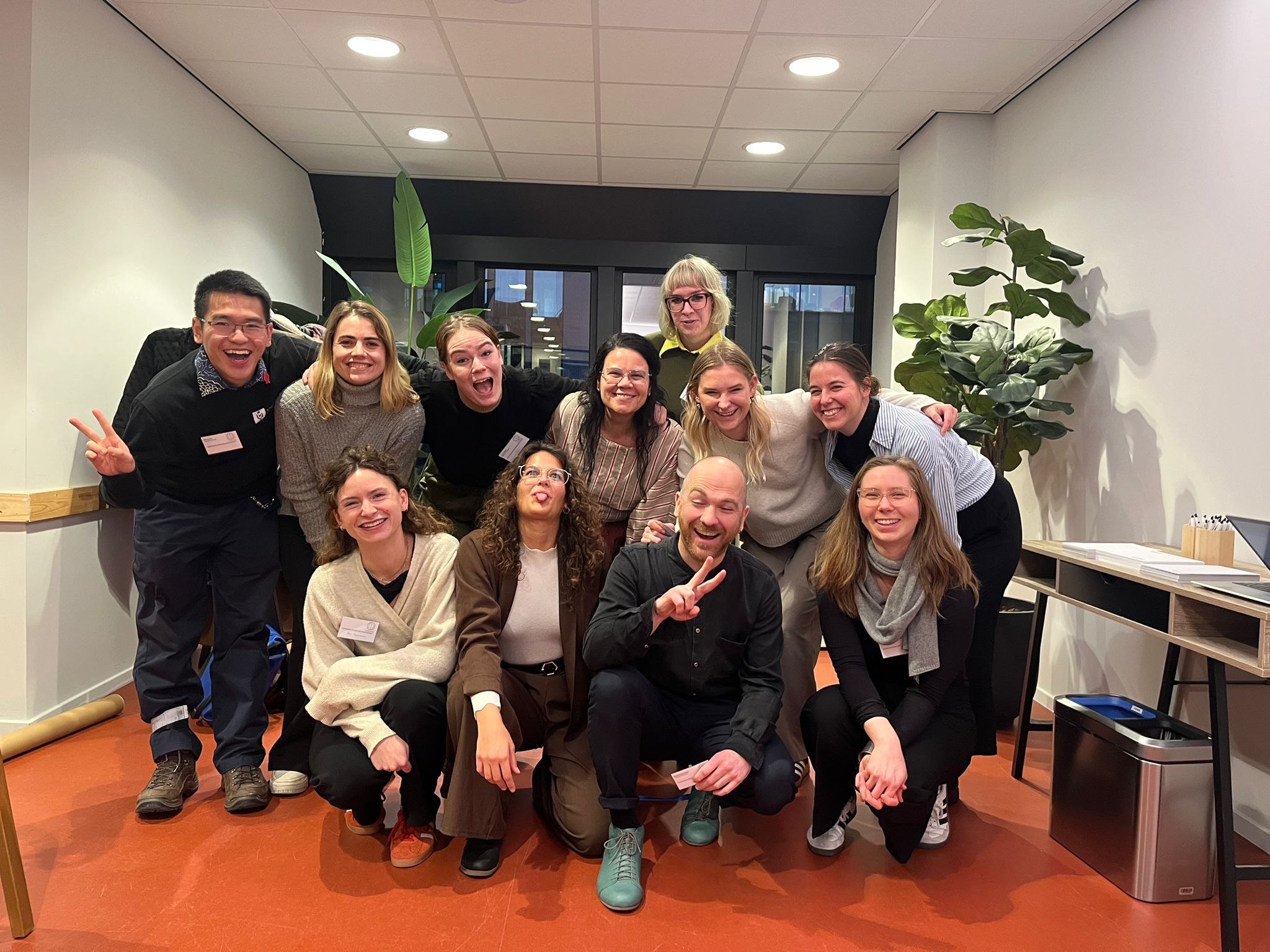
A small lab in Utrecht University tackles the big challenge: defining what it means when we “connect” with others, by measuring neural signatures of social connection through interbrain synchrony (IBS) research and hyperscanning.
A small lab in Utrecht University tackles the big challenge: defining what it means when we “connect” with others, by measuring neural signatures of social connection through interbrain synchrony (IBS) research and hyperscanning.
Ever felt yourself “click” with someone or “share a vibe” with a group? What if it was more than a metaphor, and what if we could measure it? That is the goal of the Human+ lab in Utrecht University, named after their research on social interactions between humans and various agents (e.g. social robots, pet dogs) (Van Beek et al., 2026). When I approached them in May 2024 for my Research Master’s thesis project, the team was preparing for an exciting project: researching family and group dynamics through a neurocognitive approach (Human+ Research, n.d.).
Traditionally, a social or family dynamics researcher has two main tools, each with unique benefits and drawbacks: (1) self-reports, which can be limited by response bias and participants’ ability to report their introspection, and (2) behavioural observation, which may be limited by the social desirability effect (Held et al., 2025). Neuroscience offers a third, more objective window, through which to capture subtle, often unconscious processes such as brain activity. This allows researchers to obtain a more complete picture to explain individual, dyadic, and group dynamics (Held et al., 2025). Of course, measuring a lone brain does not tell the complete story of how we interact with other minds. As I sat in their lab meetings and journal clubs, a term kept resurfacing: “hyperscanning”, the simultaneous recording of brain activity from two or more people (Holroyd, 2022).
Hyperscanning and IBS research
Previous research in cognitive neuroscience demonstrated differences in neural activity when we interact with other people, compared to when we are alone (for a review, Czeszumski et al., 2020). Indeed, in these early landmark studies, pairs engaged in cooperation, shared motor, eye contact, conversation and decision making tasks seemed to share a measurable neural signature: inter-brain synchrony (IBS), the temporal alignment of neural activity between individuals during social interactions (Azhari et al., 2025; Czeszumski et al., 2020; Dumas et al., 2010).
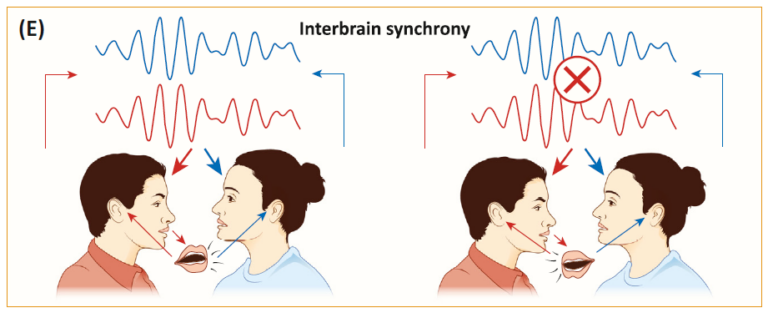
Note. From Holroyd (2022). IBS modulates (thick arrows) the social interaction (spoken communication) (left). Perturbing IBS (red X on the right) disrupts the social interaction (upside-down communication icon).
The idea that IBS may reflect a neural mechanism underlying social interaction has generated real excitement within the field of social neuroscience. However, without careful interpretation, the same excitement risks promoting implausible claims, such as linking IBS to extended consciousness or telepathy-like communication (Holroyd, 2022). I can understand why: the description of brains aligning brings to mind scenes from sci-fi movies, such as Pacific Rim, where pilots sync their brains to operate giant robots (Because Science & Hill, 2018; del Toro 2013; Etchells, 2013). Researchers warn that synchrony alone does not necessarily mean that two people are interacting (Holroyd, 2022). For example, participants watching the same movie may display similar neural responses simply because the film provides identical audiovisual input (Holroyd, 2022). This broader synchrony, encompassing both shared environment and social interaction, is sometimes referred to as neural conformity (Jones et al., 2026). If experimental designs do not adequately control for shared environmental effects, mere similarities in neural signals may be misinterpreted as neural signatures of social interaction. IBS researchers warn that, without clear definitions, and careful testing protocols, these results can lead to overgeneralised findings and reliability issues, as seen in the replication crisis within psychology and related fields (Holroyd, 2022; Jones et al., 2026; Naro, 2016).
To address this, researchers operationalise IBS as activity in one brain predicting activity in another (Jones et al., 2026), and include active control conditions to separate synchrony driven by shared external stimuli, motor-movements, or attention from true synchrony arising through social interaction (Holroyd, 2022; Jones et al., 2026). For example, Fishburn et al. (2018) compared IBS during participants’ joint completion of a puzzle with conditions in which participants (a) completed the same puzzle alone, which provided a control condition for the motor movements of completing the puzzle, (b) watched others complete the puzzle, which offered controls for visual inputs, and (c) watched a movie together, which served as a control for co-watching (Jones et al., 2026). By contrasting these conditions, researchers can isolate predictive neural patterns that emerge when people coordinate their attention and actions, and interpret these signals as measurable neural signatures of real social interaction (Djalovski et al., 2021; Jones et al., 2026).
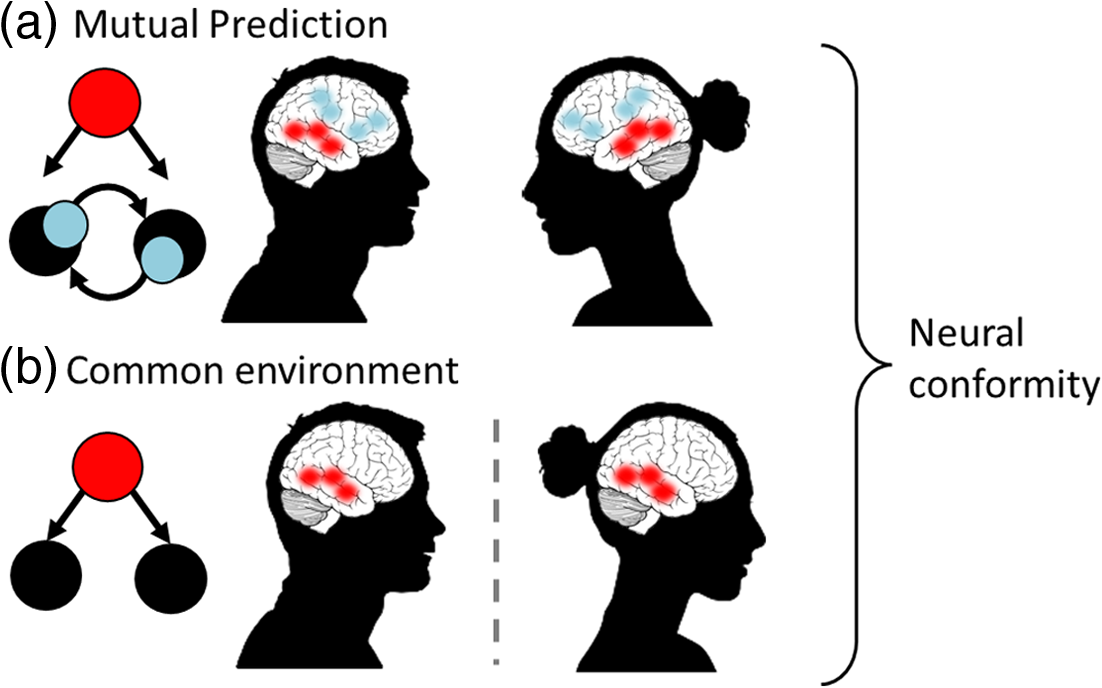 Note. From Jones et al (2026)
Studying these dynamic relationships requires experiments in which multiple brains can be recorded at the same time while participants naturally interact with one another. Such experimental setups where participants talk, move and solve problems together would be difficult to achieve inside traditional brain scanners. Recent advances in portable neuroimaging technologies have allowed researchers to develop neuroscience experiments closer to real-world social behaviour. At the Human+ Lab, this work is made possible through a lightweight brain-imaging technique known as functional near-infrared spectroscopy (fNIRS).
Functional near-infrared spectroscopy (fNIRS)
“Once upon a time, if researchers wanted to compare the brains of two people, they had to scan them one at a time, or place them in two massive machines and ask them to perform nearly identical tasks,” explains Aline Moore Loruso, a PhD researcher in the Human+ lab. Indeed, the first hyperscanning studies used functional magnetic resonance imaging (fMRI) and required participants to lie completely still in a large scanner, allowing only limited hand and eye movements (Jones et al., 2026; Montage, 2002).
Other methods offered partial solutions. Electroencephalography (EEG) can record brain activity from participants sitting face-to-face, but is relatively sensitive to movement artifacts, and can take time to set up (Intelligence, n.d.; Jones et al., 2026; Lloyd-Fox, 2017). For researchers interested in studying real-life social interactions, mobility and ease of use are essential.
This is where fNIRS stands out. fNIRS uses harmless infrared light to measure changes in blood oxygenation in the outer layers of the brain. Participants wear a lightweight cap fitted with optodes: small light emitters and detectors, allowing brain activity to be recorded while talking, moving, and interacting (Jones et al., 2026; Lloyd-Fox, 2017). Modern fNIRS systems are portable and increasingly wireless (Jones et al., 2026), allowing social neuroscientists to shift from rigid laboratory setups toward what researchers call “cognition in the wild”, studying brain activity in naturalistic settings through a mobile lab (Held et al., 2025).
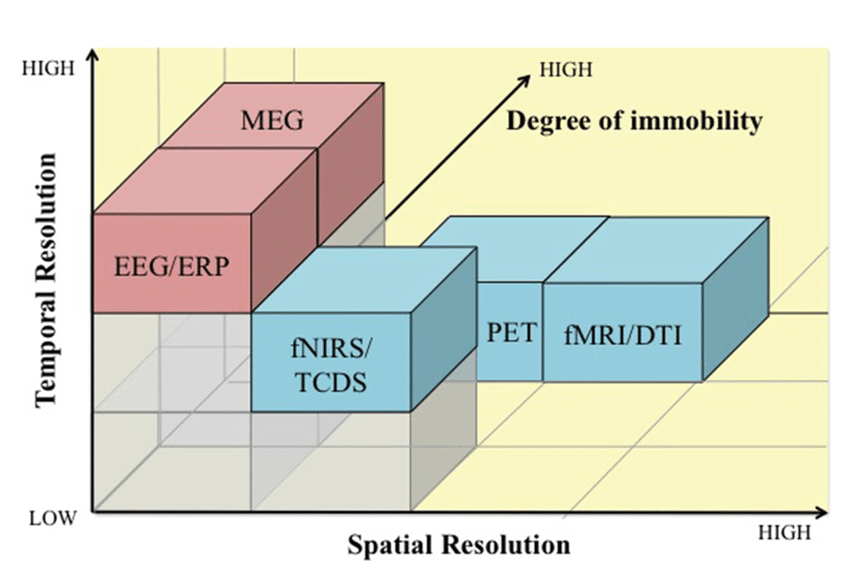 Note. From Mehta & Parasuraman (2013). A comparison of electromagnetic (pink, i.e. detecting direct activation related to electrical activity of the brain) and hemodynamic (blue; i.e. detecting changes in blood flow and oxygenation) neuroimaging techniques based on temporal resolution (x-axis), spatial resolution (y-axis), and degree of immobility (z-axis).
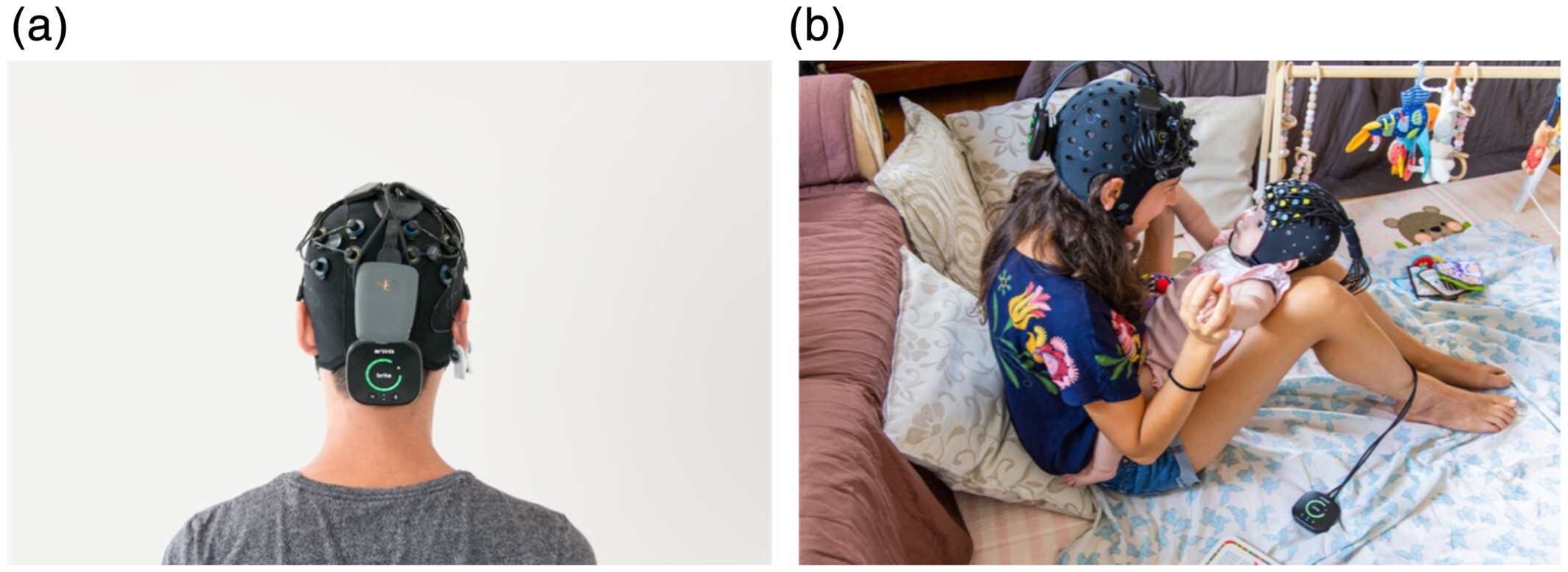 Note. From Held et al (2025), showing a mobile fNIRS system (Artinis Medical Systems, Elst, The Netherlands, www.artinis.com).
By bringing the equipment to participants rather than requiring participants to visit the lab, mobile neuroimaging opens the door for researchers to study interactions in more natural environments, such as classrooms, family homes, and even music festivals (Acquadro et al., 2016; Call Lowlands Science 2026 Geopend | NWO, 2026; Dikker et al. 2017; Greaves et al., 2022; Held et al., 2025; Lowlands Science, n.d.; Müller & Lindenberger, 2014; Universiteit van Amsterdam, 2024). The non-invasive technique also allows researchers to include vulnerable communities, such as children and families (Held et al., 2025), paving the way for researchers to investigate questions once considered nearly impossible to study through neuroscience. For example, Aline’s research on empathy investigates whether emotional alignment is correlated with brain alignment (Human+ Team Members, n.d.). Another project, F-AI-MILY, examines how interactions with artificial agents, such as voice assistants and social robots, may shape dyadic, group, or even family dynamics over time (Human+ Research, n.d.). This approach not only makes research more inclusive, but also paves the way for scientists to develop generalizable theories including whether IBS is linked to outcomes like relationship quality, teamwork, and mental health (Azhari et al., 2025; Held et al., 2025; Reinero et al., 2021). But with new techniques, researchers also encounter new challenges in maintaining reproducibility and standardisation (Holroyd, 2022; Jones et al., 2026).
fNIRS research for everyone
The biggest challenge with utilising fNIRS is that although it is a relatively novel technique, its use is rapidly expanding across fields, bringing with it a growing body of knowledge, and a steep learning curve. The use of fNIRS intersects with various disciplines such as neuroscience, physiology, and hardware engineering (Stute et al., 2025). For a newcomer like me, fNIRS felt both exciting and overwhelming.
With resources fragmented across various sites, a lack of standardized pipelines, varying devices, terms (e.g., interbrain synchrony and interpersonal synchrony, Azhari et al., 2025); emitter and transmitter, Stute et al., 2025), and practices across labs, it can be difficult for beginners to find clear guidance. Save for an initial tutorial offered by the fNIRS manufacturer, many researchers are often left to their own devices (Boda et al., 2026). “No one tells you what to do,” Dorka Boda, a former research assistant from Human+ reflects on her experience, “It can be a really lonely process.”
That’s where the fnirs4all project comes in (Boda et al., 2026). Developed by researchers at Human+, it is an open resource platform (https://fnirs4all.gitlab.io/) aimed at providing accessible explanations and lowering the technical barriers for the use of fNIRS in research and teaching across universities (fNIRS4all: Functional Near Infrared Spectroscopy for Everyone | NWO, 2024). Built on needs assessment surveys and focus group insights, the fnirs4all website features practical guides, clear explanations of key concepts, and hands-on tools for designing, running, and analysing fNIRS studies (Boda et al., 2026). Even simple things, such as defining and explaining technical terms and definitions (Stute et al., 2025), go a long way in lowering the technical barriers for the use of fNIRS, whether one is a Master’s student, a PhD candidate, a PI, or an industry user. “Our aim is to collect all the knowledge and resources that helped us, and share them with everyone working with fNIRS.”, Dorka clarifies.
Future developments of the fnirs4all platform include improved methods for accurately placing optodes, integrations with other neuroimaging tools such as EEG and tACS (Boda et al., 2026), and compatibility with devices like breathing belts to reduce interference from physiological signals (see SPA-fNIRS; Jones et al., 2026). The platform will also provide example codes and more detailed guides for hyperscanning. More importantly, fnirs4all is among the projects that reflect the Human+ team’s commitment to building a more open, collaborative research community. As Dorka puts it: “Our hope is that everyone can build this open community together, and be on the same page when it comes to fNIRS research.”
Like minds, like research
“We’ve come a long way,” Dorka reflects. “It seemed like only yesterday when two boxes of fNIRS devices from Germany arrived to the lab, and now we are running group fNIRS studies, and more!” Indeed, the Human+ team is positioned to be at the forefront of collaborative social neuroscience—hosting, for example, the Social Dynamics Workshop in 2025, where scholars share their experiences, challenges, and creative research methodologies to study human interaction. Their commitment towards dialogue between fields can also be seen in the lab: I found that even as a newcomer from Psychology, I could contribute through discussions, journal clubs, or simply by asking questions.
“We want to show that research can be fun!” Dorka says. “You spend a lot of time in the lab. But in social neuroscience, we also play games with people, study how they connect. We test how people connect with voice-assisted AIs. We test 8 people at the same time, and worry what if someone cancels. We even brought a dog to the lab!”
“I don’t think we could have done what we did if we were missing even one person,” Dorka reflects, and I am inclined to agree. It seemed only yesterday that I had the opportunity to be among such a unique combination of researchers, students, and research assistants, each bringing different perspectives and skills, but also working and coordinating in-sync. In many ways, by studying inter-brain synchrony, the Human+ team were also enacting that very process: aligning ideas and efforts to produce reproducible research, and to understand what it means to connect in a world shaped by AI.
Although my Master Thesis has long-concluded, I still find myself back with the Human+ team, lending a hand with workshops, or just for a cozy hangout, catching up on doing good science, and most importantly, having a good time. “It’s not about expensive equipment,” Dorka emphasises, “it’s about the people and team.”
On that, I believe we can be on the same wavelength.
Acknowledgements
We thank all the involved members of the Human+ team for their contributions towards this article (https://human-plus.gitlab.io/).
This article lends some sources from Ella Teuscher’s Hyperscanning Human Connection draft meant for issue 419: Harmony (2022).
This article shares the same title with the In-Mind magazine article by Vrtička and Nguyen (2024), which can be found here: (https://www.in-mind.org/article/on-the-same-wavelength-do-parents-and-children-understand-each-other-better-if-their-brains)
References
- Acquadro, M. A. S., Congedo, M., & De Riddeer, D. (2016). Music Performance As an Experimental Approach to Hyperscanning Studies. Frontiers in Human Neuroscience, 10. https://doi.org/10.3389/fnhum.2016.00242
- Azhari, A., Rai, A., & Chua, Y. V. (2025). A Systematic Review of Inter-Brain Synchrony and Psychological Conditions: Stress, Anxiety, Depression, Autism and Other Disorders. Brain Sciences, 15(10), 1113. https://doi.org/10.3390/brainsci15101113
- Because Science, & Hill, K. (2018, March 15). Why do Pacific Rim jaegers need two brains? | Because science w/ Kyle Hill [Video]. YouTube. Retrieved March 23, 2026, from https://www.youtube.com/watch?v=F_SH8nkZqGQ
- Boda, D., van Beek, H., Maarseveen, J., Nikolic, M., van Nunspeet, F., Will, G., & Hortensius, R. (2026, April 2). fnirs4all – an open-source knowledge hub for fNIRS researchers. Retrieved from https://osf.io/preprints/psyarxiv/y5hn8_v1
- Call Lowlands Science 2026 geopend | NWO. (2026, February 12). NWO. https://www.nwo.nl/nieuws/call-lowlands-science-2026-geopend
- Cortivision. (n.d.). FNIRS. devices to measure brain activity – Cortivision. Retrieved March 12, 2026, from https://www.cortivision.com/
- Czeszumski, A., Eustergerling, S., Lang, A., Menrath, D., Gerstenberger, M., Schuberth, S., Schreiber, F., Rendon, Z. Z., & König, P. (2020). Hyperscanning: A Valid Method to Study Neural Inter-brain Underpinnings of Social Interaction. Frontiers in Human Neuroscience, 14. https://doi.org/10.3389/fnhum.2020.00039
- del Toro, G. (2013). Pacific Rim. Warner Bros.
- Dikker, S., L. Wan, I. Davidesco, et al. 2017. “Brain-To-Brain Synchrony Tracks Real-World Dynamic Group Interactions in the Classroom.” Current Biology 27, no. 9: 1375–1380. https://doi.org/10.1016/j.cub.2017. 04.002.
- Djalovski, A., Dumas, G., Kinreich, S., & Feldman, R. (2021). Human attachments shape interbrain synchrony toward efficient performance of social goals. NeuroImage, 226, 117600. https://doi.org/10.1016/j.neuroimage.2020.117600
- Dumas, G., Nadel, J., Soussignan, R., Martinerie, J., & Garnero, L. (2010). Inter-brain synchronization during social interaction. PloS one, 5(8), e12166. https://doi.org/10.1371/journal.pone.0012166
- ERC Starting Grant for seven Utrecht-based researchers. (2023, September 5). Utrecht University. Retrieved March 12, 2026, from https://www.uu.nl/en/news/erc-starting-grant-for-seven-utrecht-based-researchers
- Etchells, P. (2013, August 8). Are two heads better than one? The Psychology of Pacific Rim. The Guardian. https://www.theguardian.com/science/head-quarters/2013/aug/08/two-heads-one-psychology-pacific-rim
- Fishburn, F. A., Murty, V. P., Hlutkowsky, C. O., MacGillivray, C. E., Bemis, L. M., Murphy, M. E., … & Perlman, S. B. (2018). Putting our heads together: interpersonal neural synchronization as a biological mechanism for shared intentionality. Social cognitive and affective neuroscience, 13(8), 841-849. https://doi.org/10.1093/scan/nsy060
- fNIRS4all: Functional near infrared spectroscopy for everyone | NWO. (2024). NWO. https://www.nwo.nl/en/projects/osf232018
- fnirs4all. (n.d.). https://fnirs4all.gitlab.io/
- Greaves, D. A., Pinti, P., Din, S., Hickson, R., Diao, M., Lange, C., … & Hamilton, A. F. D. C. (2022). Exploring theater neuroscience: using wearable functional near-infrared spectroscopy to measure the sense of self and interpersonal coordination in professional actors. Journal of Cognitive Neuroscience, 34(12), 2215-2236. https://doi.org/10.1162/jocn_a_01912.
- Held, R. F., Moore Lorusso, A., Hogenhuis, A. L., Kluwer, E. S., & Hortensius, R. (2025). Understanding family dynamics through a neurocognitive lens. Journal of Family Theory & Review. https://doi.org/10.1111/jftr.70018
- Holroyd, C. B. (2022). Interbrain synchrony: on wavy ground. Trends in Neurosciences, 45(5), 346-357. https://doi.org/10.1016/j.tins.2022.02.002
- Human+. (n.d.). https://human-plus.gitlab.io/
- Human+ Research. (n.d.). https://human-plus.gitlab.io/research/
- Human+ team members. (n.d.). Retrieved April 17, 2026, from https://human-plus.gitlab.io/members/
- Intelligence, G. (n.d.). FNIRS vs EEG: Which tool is best for your cognitive neuroscience. GAZE INTELLIGENCE. Retrieved March 12, 2026, from https://gazeintelligence.com/about-us/f/fnirs-vs-eeg-which-tool-is-best-for-your-cognitive-neuroscience
- Jones, I. L., Bulgarelli, C., De Felice, S., Pinti, P., & Hamilton, A. F. D. C. (2026). How to design real-world functional near-infrared spectroscopy studies: a primer. Neurophotonics, 13(S1), S10701-S10701. https://doi.org/10.1117/1.NPh.13.S1.S10701
- Lloyd-Fox, S. (2017). Functional near-infrared spectroscopy. In B. Hopkins, E. Geangu, & S. Linkenauger (Eds.), The Cambridge Encyclopedia of Child Development (pp. 129–136). chapter, Cambridge: Cambridge University Press. https://doi.org/10.1017/9781316216491.022
- Mehta, R. K., & Parasuraman, R. (2013). Neuroergonomics: a review of applications to physical and cognitive work. Frontiers in human neuroscience, 7, 889. https://doi.org/10.3389/fnhum.2013.00889
- Montague, P. (2002). Hyperscanning: Simultaneous fMRI during Linked Social Interactions. NeuroImage, 16(4), 1159–1164. https://doi.org/10.1006/nimg.2002.1150
- Müller, V., & Lindenberger, U. (2014). Hyper-Brain Networks Support Romantic Kissing in Humans. PLoS ONE, 9(11), e112080. https://doi.org/10.1371/journal.pone.0112080
- Naro, M. (2016, October 6). Repeat After Me | The NIB. The Nib. Retrieved March 23, 2026, from https://thenib.com/repeat-after-me/
- NIRS devices — Artinis medical systems | (F)NIRS devices. (n.d.). Artinis Medical Systems | (F)NIRS Devices. Retrieved March 12, 2026, from https://www.artinis.com/nirs-devices
- NIRX | FNIRS Systems | NIRS Devices. (2025, July 8). NIRx Medical Technologies. Retrieved March 12, 2026, from https://nirx.net/
- Reinero, D. A., Dikker, S., & Van Bavel, J. J. (2021). Inter-brain synchrony in teams predicts collective performance. Social cognitive and affective neuroscience, 16(1-2), 43-57. https://doi.org/10.31234/osf.io/k2ft6
- Social Dynamics 2025 | Universiteit Utrecht. (n.d.). Social Dynamics 2025. https://socialdynamics2025.sites.uu.nl/
- Stute, K., Gossé, L. K., Montero-Hernandez, S., Perkins, G. A., Yücel, M. A., Cutini, S., … & Zainodini, H. (2025). The fNIRS glossary project: a consensus-based resource for functional near-infrared spectroscopy terminology. Neurophotonics, 12(2), 027801-027801. https://doi.org/10.1117/1.NPh.12.2.027801
- Universiteit van Amsterdam. (2024, October 2). Performing under pressure: how a glass booth at Lowlands is linked to equality of opportunity. University of Amsterdam. https://www.uva.nl/en/shared-content/faculteiten/en/faculteit-der-maatschappij-en-gedragswetenschappen/news/2024/10-1/lowlands-performing-under-pressure.html
- Van Beek, H. M., Boda, D., Diana, F., Held, R. F., Hogenhuis, A. L., Lorusso, A. M., & Hortensius, R. (2026). Seven questions on perceiving and understanding other minds. Behaviour, 1(aop), 1-26. https://doi.org/10.1163/1568539X-bja10345
- Vrtička, P., & Nguyen, T. (2024). On the same wavelength—Do parents and children understand each other better if their brains are “in sync”? | Magazine Issue 11/2024 – Issue 55 |. In-Mind. https://www.in-mind.org/article/on-the-same-wavelength-do-parents-and-children-understand-each-other-better-if-their-brains
Ever felt yourself “click” with someone or “share a vibe” with a group? What if it was more than a metaphor, and what if we could measure it? That is the goal of the Human+ lab in Utrecht University, named after their research on social interactions between humans and various agents (e.g. social robots, pet dogs) (Van Beek et al., 2026). When I approached them in May 2024 for my Research Master’s thesis project, the team was preparing for an exciting project: researching family and group dynamics through a neurocognitive approach (Human+ Research, n.d.).
Traditionally, a social or family dynamics researcher has two main tools, each with unique benefits and drawbacks: (1) self-reports, which can be limited by response bias and participants’ ability to report their introspection, and (2) behavioural observation, which may be limited by the social desirability effect (Held et al., 2025). Neuroscience offers a third, more objective window, through which to capture subtle, often unconscious processes such as brain activity. This allows researchers to obtain a more complete picture to explain individual, dyadic, and group dynamics (Held et al., 2025). Of course, measuring a lone brain does not tell the complete story of how we interact with other minds. As I sat in their lab meetings and journal clubs, a term kept resurfacing: “hyperscanning”, the simultaneous recording of brain activity from two or more people (Holroyd, 2022).
Hyperscanning and IBS research
Previous research in cognitive neuroscience demonstrated differences in neural activity when we interact with other people, compared to when we are alone (for a review, Czeszumski et al., 2020). Indeed, in these early landmark studies, pairs engaged in cooperation, shared motor, eye contact, conversation and decision making tasks seemed to share a measurable neural signature: inter-brain synchrony (IBS), the temporal alignment of neural activity between individuals during social interactions (Azhari et al., 2025; Czeszumski et al., 2020; Dumas et al., 2010).
Note. From Holroyd (2022). IBS modulates (thick arrows) the social interaction (spoken communication) (left). Perturbing IBS (red X on the right) disrupts the social interaction (upside-down communication icon).
The idea that IBS may reflect a neural mechanism underlying social interaction has generated real excitement within the field of social neuroscience. However, without careful interpretation, the same excitement risks promoting implausible claims, such as linking IBS to extended consciousness or telepathy-like communication (Holroyd, 2022). I can understand why: the description of brains aligning brings to mind scenes from sci-fi movies, such as Pacific Rim, where pilots sync their brains to operate giant robots (Because Science & Hill, 2018; del Toro 2013; Etchells, 2013). Researchers warn that synchrony alone does not necessarily mean that two people are interacting (Holroyd, 2022). For example, participants watching the same movie may display similar neural responses simply because the film provides identical audiovisual input (Holroyd, 2022). This broader synchrony, encompassing both shared environment and social interaction, is sometimes referred to as neural conformity (Jones et al., 2026). If experimental designs do not adequately control for shared environmental effects, mere similarities in neural signals may be misinterpreted as neural signatures of social interaction. IBS researchers warn that, without clear definitions, and careful testing protocols, these results can lead to overgeneralised findings and reliability issues, as seen in the replication crisis within psychology and related fields (Holroyd, 2022; Jones et al., 2026; Naro, 2016).
To address this, researchers operationalise IBS as activity in one brain predicting activity in another (Jones et al., 2026), and include active control conditions to separate synchrony driven by shared external stimuli, motor-movements, or attention from true synchrony arising through social interaction (Holroyd, 2022; Jones et al., 2026). For example, Fishburn et al. (2018) compared IBS during participants’ joint completion of a puzzle with conditions in which participants (a) completed the same puzzle alone, which provided a control condition for the motor movements of completing the puzzle, (b) watched others complete the puzzle, which offered controls for visual inputs, and (c) watched a movie together, which served as a control for co-watching (Jones et al., 2026). By contrasting these conditions, researchers can isolate predictive neural patterns that emerge when people coordinate their attention and actions, and interpret these signals as measurable neural signatures of real social interaction (Djalovski et al., 2021; Jones et al., 2026).
Note. From Jones et al (2026)
Studying these dynamic relationships requires experiments in which multiple brains can be recorded at the same time while participants naturally interact with one another. Such experimental setups where participants talk, move and solve problems together would be difficult to achieve inside traditional brain scanners. Recent advances in portable neuroimaging technologies have allowed researchers to develop neuroscience experiments closer to real-world social behaviour. At the Human+ Lab, this work is made possible through a lightweight brain-imaging technique known as functional near-infrared spectroscopy (fNIRS).
Functional near-infrared spectroscopy (fNIRS)
“Once upon a time, if researchers wanted to compare the brains of two people, they had to scan them one at a time, or place them in two massive machines and ask them to perform nearly identical tasks,” explains Aline Moore Loruso, a PhD researcher in the Human+ lab. Indeed, the first hyperscanning studies used functional magnetic resonance imaging (fMRI) and required participants to lie completely still in a large scanner, allowing only limited hand and eye movements (Jones et al., 2026; Montage, 2002).
Other methods offered partial solutions. Electroencephalography (EEG) can record brain activity from participants sitting face-to-face, but is relatively sensitive to movement artifacts, and can take time to set up (Intelligence, n.d.; Jones et al., 2026; Lloyd-Fox, 2017). For researchers interested in studying real-life social interactions, mobility and ease of use are essential.
This is where fNIRS stands out. fNIRS uses harmless infrared light to measure changes in blood oxygenation in the outer layers of the brain. Participants wear a lightweight cap fitted with optodes: small light emitters and detectors, allowing brain activity to be recorded while talking, moving, and interacting (Jones et al., 2026; Lloyd-Fox, 2017). Modern fNIRS systems are portable and increasingly wireless (Jones et al., 2026), allowing social neuroscientists to shift from rigid laboratory setups toward what researchers call “cognition in the wild”, studying brain activity in naturalistic settings through a mobile lab (Held et al., 2025).
Note. From Mehta & Parasuraman (2013). A comparison of electromagnetic (pink, i.e. detecting direct activation related to electrical activity of the brain) and hemodynamic (blue; i.e. detecting changes in blood flow and oxygenation) neuroimaging techniques based on temporal resolution (x-axis), spatial resolution (y-axis), and degree of immobility (z-axis).
Note. From Held et al (2025), showing a mobile fNIRS system (Artinis Medical Systems, Elst, The Netherlands, www.artinis.com).
By bringing the equipment to participants rather than requiring participants to visit the lab, mobile neuroimaging opens the door for researchers to study interactions in more natural environments, such as classrooms, family homes, and even music festivals (Acquadro et al., 2016; Call Lowlands Science 2026 Geopend | NWO, 2026; Dikker et al. 2017; Greaves et al., 2022; Held et al., 2025; Lowlands Science, n.d.; Müller & Lindenberger, 2014; Universiteit van Amsterdam, 2024). The non-invasive technique also allows researchers to include vulnerable communities, such as children and families (Held et al., 2025), paving the way for researchers to investigate questions once considered nearly impossible to study through neuroscience. For example, Aline’s research on empathy investigates whether emotional alignment is correlated with brain alignment (Human+ Team Members, n.d.). Another project, F-AI-MILY, examines how interactions with artificial agents, such as voice assistants and social robots, may shape dyadic, group, or even family dynamics over time (Human+ Research, n.d.). This approach not only makes research more inclusive, but also paves the way for scientists to develop generalizable theories including whether IBS is linked to outcomes like relationship quality, teamwork, and mental health (Azhari et al., 2025; Held et al., 2025; Reinero et al., 2021). But with new techniques, researchers also encounter new challenges in maintaining reproducibility and standardisation (Holroyd, 2022; Jones et al., 2026).
fNIRS research for everyone
The biggest challenge with utilising fNIRS is that although it is a relatively novel technique, its use is rapidly expanding across fields, bringing with it a growing body of knowledge, and a steep learning curve. The use of fNIRS intersects with various disciplines such as neuroscience, physiology, and hardware engineering (Stute et al., 2025). For a newcomer like me, fNIRS felt both exciting and overwhelming.
With resources fragmented across various sites, a lack of standardized pipelines, varying devices, terms (e.g., interbrain synchrony and interpersonal synchrony, Azhari et al., 2025); emitter and transmitter, Stute et al., 2025), and practices across labs, it can be difficult for beginners to find clear guidance. Save for an initial tutorial offered by the fNIRS manufacturer, many researchers are often left to their own devices (Boda et al., 2026). “No one tells you what to do,” Dorka Boda, a former research assistant from Human+ reflects on her experience, “It can be a really lonely process.”
That’s where the fnirs4all project comes in (Boda et al., 2026). Developed by researchers at Human+, it is an open resource platform (https://fnirs4all.gitlab.io/) aimed at providing accessible explanations and lowering the technical barriers for the use of fNIRS in research and teaching across universities (fNIRS4all: Functional Near Infrared Spectroscopy for Everyone | NWO, 2024). Built on needs assessment surveys and focus group insights, the fnirs4all website features practical guides, clear explanations of key concepts, and hands-on tools for designing, running, and analysing fNIRS studies (Boda et al., 2026). Even simple things, such as defining and explaining technical terms and definitions (Stute et al., 2025), go a long way in lowering the technical barriers for the use of fNIRS, whether one is a Master’s student, a PhD candidate, a PI, or an industry user. “Our aim is to collect all the knowledge and resources that helped us, and share them with everyone working with fNIRS.”, Dorka clarifies.
Future developments of the fnirs4all platform include improved methods for accurately placing optodes, integrations with other neuroimaging tools such as EEG and tACS (Boda et al., 2026), and compatibility with devices like breathing belts to reduce interference from physiological signals (see SPA-fNIRS; Jones et al., 2026). The platform will also provide example codes and more detailed guides for hyperscanning. More importantly, fnirs4all is among the projects that reflect the Human+ team’s commitment to building a more open, collaborative research community. As Dorka puts it: “Our hope is that everyone can build this open community together, and be on the same page when it comes to fNIRS research.”
Like minds, like research
“We’ve come a long way,” Dorka reflects. “It seemed like only yesterday when two boxes of fNIRS devices from Germany arrived to the lab, and now we are running group fNIRS studies, and more!” Indeed, the Human+ team is positioned to be at the forefront of collaborative social neuroscience—hosting, for example, the Social Dynamics Workshop in 2025, where scholars share their experiences, challenges, and creative research methodologies to study human interaction. Their commitment towards dialogue between fields can also be seen in the lab: I found that even as a newcomer from Psychology, I could contribute through discussions, journal clubs, or simply by asking questions.
“We want to show that research can be fun!” Dorka says. “You spend a lot of time in the lab. But in social neuroscience, we also play games with people, study how they connect. We test how people connect with voice-assisted AIs. We test 8 people at the same time, and worry what if someone cancels. We even brought a dog to the lab!”
“I don’t think we could have done what we did if we were missing even one person,” Dorka reflects, and I am inclined to agree. It seemed only yesterday that I had the opportunity to be among such a unique combination of researchers, students, and research assistants, each bringing different perspectives and skills, but also working and coordinating in-sync. In many ways, by studying inter-brain synchrony, the Human+ team were also enacting that very process: aligning ideas and efforts to produce reproducible research, and to understand what it means to connect in a world shaped by AI.
Although my Master Thesis has long-concluded, I still find myself back with the Human+ team, lending a hand with workshops, or just for a cozy hangout, catching up on doing good science, and most importantly, having a good time. “It’s not about expensive equipment,” Dorka emphasises, “it’s about the people and team.”
On that, I believe we can be on the same wavelength.
Acknowledgements
We thank all the involved members of the Human+ team for their contributions towards this article (https://human-plus.gitlab.io/).
This article lends some sources from Ella Teuscher’s Hyperscanning Human Connection draft meant for issue 419: Harmony (2022).
This article shares the same title with the In-Mind magazine article by Vrtička and Nguyen (2024), which can be found here: (https://www.in-mind.org/article/on-the-same-wavelength-do-parents-and-children-understand-each-other-better-if-their-brains)
References
- Acquadro, M. A. S., Congedo, M., & De Riddeer, D. (2016). Music Performance As an Experimental Approach to Hyperscanning Studies. Frontiers in Human Neuroscience, 10. https://doi.org/10.3389/fnhum.2016.00242
- Azhari, A., Rai, A., & Chua, Y. V. (2025). A Systematic Review of Inter-Brain Synchrony and Psychological Conditions: Stress, Anxiety, Depression, Autism and Other Disorders. Brain Sciences, 15(10), 1113. https://doi.org/10.3390/brainsci15101113
- Because Science, & Hill, K. (2018, March 15). Why do Pacific Rim jaegers need two brains? | Because science w/ Kyle Hill [Video]. YouTube. Retrieved March 23, 2026, from https://www.youtube.com/watch?v=F_SH8nkZqGQ
- Boda, D., van Beek, H., Maarseveen, J., Nikolic, M., van Nunspeet, F., Will, G., & Hortensius, R. (2026, April 2). fnirs4all – an open-source knowledge hub for fNIRS researchers. Retrieved from https://osf.io/preprints/psyarxiv/y5hn8_v1
- Call Lowlands Science 2026 geopend | NWO. (2026, February 12). NWO. https://www.nwo.nl/nieuws/call-lowlands-science-2026-geopend
- Cortivision. (n.d.). FNIRS. devices to measure brain activity – Cortivision. Retrieved March 12, 2026, from https://www.cortivision.com/
- Czeszumski, A., Eustergerling, S., Lang, A., Menrath, D., Gerstenberger, M., Schuberth, S., Schreiber, F., Rendon, Z. Z., & König, P. (2020). Hyperscanning: A Valid Method to Study Neural Inter-brain Underpinnings of Social Interaction. Frontiers in Human Neuroscience, 14. https://doi.org/10.3389/fnhum.2020.00039
- del Toro, G. (2013). Pacific Rim. Warner Bros.
- Dikker, S., L. Wan, I. Davidesco, et al. 2017. “Brain-To-Brain Synchrony Tracks Real-World Dynamic Group Interactions in the Classroom.” Current Biology 27, no. 9: 1375–1380. https://doi.org/10.1016/j.cub.2017. 04.002.
- Djalovski, A., Dumas, G., Kinreich, S., & Feldman, R. (2021). Human attachments shape interbrain synchrony toward efficient performance of social goals. NeuroImage, 226, 117600. https://doi.org/10.1016/j.neuroimage.2020.117600
- Dumas, G., Nadel, J., Soussignan, R., Martinerie, J., & Garnero, L. (2010). Inter-brain synchronization during social interaction. PloS one, 5(8), e12166. https://doi.org/10.1371/journal.pone.0012166
- ERC Starting Grant for seven Utrecht-based researchers. (2023, September 5). Utrecht University. Retrieved March 12, 2026, from https://www.uu.nl/en/news/erc-starting-grant-for-seven-utrecht-based-researchers
- Etchells, P. (2013, August 8). Are two heads better than one? The Psychology of Pacific Rim. The Guardian. https://www.theguardian.com/science/head-quarters/2013/aug/08/two-heads-one-psychology-pacific-rim
- Fishburn, F. A., Murty, V. P., Hlutkowsky, C. O., MacGillivray, C. E., Bemis, L. M., Murphy, M. E., … & Perlman, S. B. (2018). Putting our heads together: interpersonal neural synchronization as a biological mechanism for shared intentionality. Social cognitive and affective neuroscience, 13(8), 841-849. https://doi.org/10.1093/scan/nsy060
- fNIRS4all: Functional near infrared spectroscopy for everyone | NWO. (2024). NWO. https://www.nwo.nl/en/projects/osf232018
- fnirs4all. (n.d.). https://fnirs4all.gitlab.io/
- Greaves, D. A., Pinti, P., Din, S., Hickson, R., Diao, M., Lange, C., … & Hamilton, A. F. D. C. (2022). Exploring theater neuroscience: using wearable functional near-infrared spectroscopy to measure the sense of self and interpersonal coordination in professional actors. Journal of Cognitive Neuroscience, 34(12), 2215-2236. https://doi.org/10.1162/jocn_a_01912.
- Held, R. F., Moore Lorusso, A., Hogenhuis, A. L., Kluwer, E. S., & Hortensius, R. (2025). Understanding family dynamics through a neurocognitive lens. Journal of Family Theory & Review. https://doi.org/10.1111/jftr.70018
- Holroyd, C. B. (2022). Interbrain synchrony: on wavy ground. Trends in Neurosciences, 45(5), 346-357. https://doi.org/10.1016/j.tins.2022.02.002
- Human+. (n.d.). https://human-plus.gitlab.io/
- Human+ Research. (n.d.). https://human-plus.gitlab.io/research/
- Human+ team members. (n.d.). Retrieved April 17, 2026, from https://human-plus.gitlab.io/members/
- Intelligence, G. (n.d.). FNIRS vs EEG: Which tool is best for your cognitive neuroscience. GAZE INTELLIGENCE. Retrieved March 12, 2026, from https://gazeintelligence.com/about-us/f/fnirs-vs-eeg-which-tool-is-best-for-your-cognitive-neuroscience
- Jones, I. L., Bulgarelli, C., De Felice, S., Pinti, P., & Hamilton, A. F. D. C. (2026). How to design real-world functional near-infrared spectroscopy studies: a primer. Neurophotonics, 13(S1), S10701-S10701. https://doi.org/10.1117/1.NPh.13.S1.S10701
- Lloyd-Fox, S. (2017). Functional near-infrared spectroscopy. In B. Hopkins, E. Geangu, & S. Linkenauger (Eds.), The Cambridge Encyclopedia of Child Development (pp. 129–136). chapter, Cambridge: Cambridge University Press. https://doi.org/10.1017/9781316216491.022
- Mehta, R. K., & Parasuraman, R. (2013). Neuroergonomics: a review of applications to physical and cognitive work. Frontiers in human neuroscience, 7, 889. https://doi.org/10.3389/fnhum.2013.00889
- Montague, P. (2002). Hyperscanning: Simultaneous fMRI during Linked Social Interactions. NeuroImage, 16(4), 1159–1164. https://doi.org/10.1006/nimg.2002.1150
- Müller, V., & Lindenberger, U. (2014). Hyper-Brain Networks Support Romantic Kissing in Humans. PLoS ONE, 9(11), e112080. https://doi.org/10.1371/journal.pone.0112080
- Naro, M. (2016, October 6). Repeat After Me | The NIB. The Nib. Retrieved March 23, 2026, from https://thenib.com/repeat-after-me/
- NIRS devices — Artinis medical systems | (F)NIRS devices. (n.d.). Artinis Medical Systems | (F)NIRS Devices. Retrieved March 12, 2026, from https://www.artinis.com/nirs-devices
- NIRX | FNIRS Systems | NIRS Devices. (2025, July 8). NIRx Medical Technologies. Retrieved March 12, 2026, from https://nirx.net/
- Reinero, D. A., Dikker, S., & Van Bavel, J. J. (2021). Inter-brain synchrony in teams predicts collective performance. Social cognitive and affective neuroscience, 16(1-2), 43-57. https://doi.org/10.31234/osf.io/k2ft6
- Social Dynamics 2025 | Universiteit Utrecht. (n.d.). Social Dynamics 2025. https://socialdynamics2025.sites.uu.nl/
- Stute, K., Gossé, L. K., Montero-Hernandez, S., Perkins, G. A., Yücel, M. A., Cutini, S., … & Zainodini, H. (2025). The fNIRS glossary project: a consensus-based resource for functional near-infrared spectroscopy terminology. Neurophotonics, 12(2), 027801-027801. https://doi.org/10.1117/1.NPh.12.2.027801
- Universiteit van Amsterdam. (2024, October 2). Performing under pressure: how a glass booth at Lowlands is linked to equality of opportunity. University of Amsterdam. https://www.uva.nl/en/shared-content/faculteiten/en/faculteit-der-maatschappij-en-gedragswetenschappen/news/2024/10-1/lowlands-performing-under-pressure.html
- Van Beek, H. M., Boda, D., Diana, F., Held, R. F., Hogenhuis, A. L., Lorusso, A. M., & Hortensius, R. (2026). Seven questions on perceiving and understanding other minds. Behaviour, 1(aop), 1-26. https://doi.org/10.1163/1568539X-bja10345
- Vrtička, P., & Nguyen, T. (2024). On the same wavelength—Do parents and children understand each other better if their brains are “in sync”? | Magazine Issue 11/2024 – Issue 55 |. In-Mind. https://www.in-mind.org/article/on-the-same-wavelength-do-parents-and-children-understand-each-other-better-if-their-brains
