
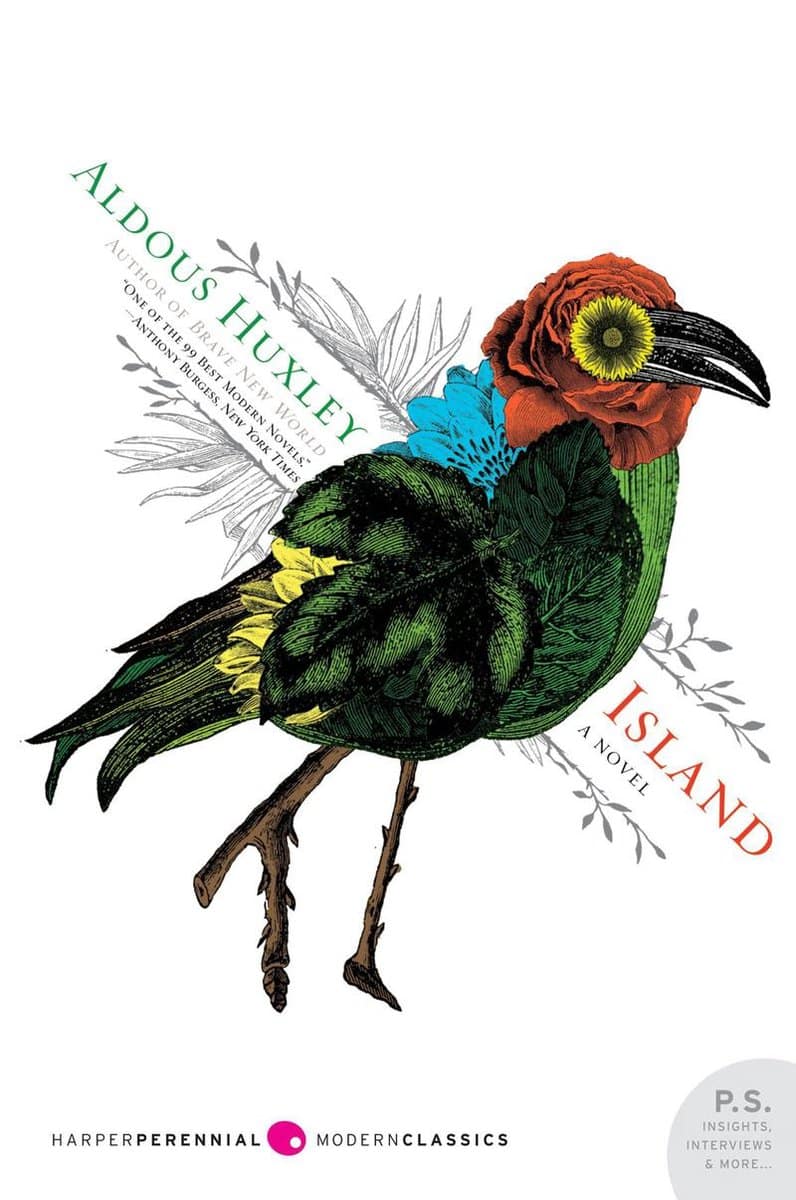
Aldous Huxley’s Island is a revolutionary book in itself: written in 1962, it is a utopian counterpart to his famous dystopian Brave New World, raising questions and introducing ideas far ahead of their time. Instead of warning us about a dystopian future, in this book, Huxley imagines a utopian society completely different from our own. Huxley uses this contrast to question what we define as progress, and whether there might be a superior alternative.
The book follows the journalist Will Farnaby, who gets stranded on the island of Pala, which is completely separated from the rest of the world. Under normal circumstances, outsiders are not allowed on the island, but Will’s injuries grant him an exception, and enable him to experience life in this paradisiacal environment while he recovers. However, Will is not just a journalist, and his arrival on the island is not without ulterior motive. He is also working for Joe Aldehyde, an oil merchant who wants to buy the rights to the island’s natural, untouched oil reserves. The island itself never underwent an industrial revolution, and instead placed their focus on ecology, mental health and community rather than economic growth. To allow Joe Aldehyde access to the oil reserves would mean inviting industrialisation onto the island, which the inhabitants spent so much time and effort avoiding.
Throughout the story, as Will slowly recovers, his initial feelings of Western superiority diminish. Through his interactions with different people on the island, who introduce him to their unique approaches to different social systems like healthcare, education and the raising of children, he gradually learns to appreciate this alternative way of life. Slowly, he falls in love with Susila MacPhail, who helps him deal with his past trauma and his current injuries through a hypnosis-like technique. All of this raises doubts in Will about whether implementing the oil-deal would be the right decision for the people of Pala. The outside world views progress as technical acceleration and the accumulation of power and wealth, while Pala has its own idea: progress as the elevation of human wellbeing. Will’s experience on the island leads him to question the values of industrialisation, as he comes to recognize the inevitable regression in human wellbeing and community that come with it. These increasingly conflictual views on the meaning of progress finally force Will to make a choice between what he really believes is more important.
While this choice is important in determining the future of the island, Will is not the only catalyst for change within Pala. Both the leader of the island, the Rani and her son, Murugan, have been influenced by the outside world and are openly against some of the systems of the island. Murugan, who spent a few months in Switzerland to study, is for example strongly influenced by consumerism, power, and militarism. This makes him plan on modernizing Pala as soon as he assumes power, as he disdains what he sees as an “old-fashioned” way of living. Therefore, while Will’s presence is definitely a driver for change, other people are influential in instituting a “revolution”. Interestingly, the only people at odds with the Pala way of life are those who have been to the outside world, suggesting a “corruption” that comes from outside Pala.
A true utopia – a state where everyone is happy with the status quo – would not need any revolutions. If the Rani and Murugan are dissatisfied and do strive for change, does that make Pala a false one? Or is dissatisfaction not a prerequisite for revolutions and revolutions can arise from contentment? Is the grass always greener on the other side, and complete appreciation and gratitude a myth incompatible with human nature? Can a utopia ever be a utopia for everyone?
Importantly, the utopia clearly differs from our current world. While some elements have a scientific basis, such as psychological theories about how children develop, other elements almost seem magical: healing injuries through hypnosis, achieving new states of consciousness through the moksha medicine, a non-addictive, mystical drug, or an early recognition and change of certain qualities like the need for power in children. This raises the question of whether these utopian ideas are merely fantasy, or whether revolutions of a different kind can turn them into a future reality; whether utopian thinking is naive or a revolution in itself? How do we change the future, if not by thinking outside the box and imagining things that seem like “fantasy” at first glance? If we were to show airplanes or smartphones to people from the Stone Age, wouldn’t they seem like fantasy to them? As humans we are also so strongly influenced by our upbringing, which limits our understanding of what is, and what can (not) be. In a different world, we might not expect every person to be power-hungry and greedy, and would see human nature in a very different light.
Maybe both Will and, in writing this book, Huxley went through small revolutions themselves: by realizing that our idea of revolution and progress, focused on technical acceleration and the strive for power and money, might be limited, and that community, support, and happiness are far more important. That a true revolution lies in bettering the world and imagining a brighter future for all humans.
Island is available at bookstores or online starting at €15.00.
